
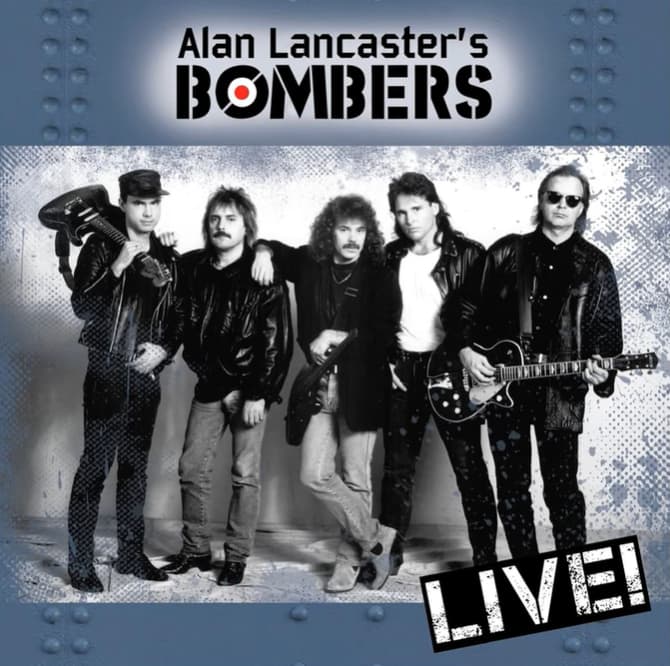
A Farewell Before the Fall: The Bombers and the Quiet Truth Behind “Is This The Way To Say Goodbye”
By 1990, The Bombers looked, on paper, like a band built for success. Formed by seasoned musicians with roots in groups like Status Quo and The Angels, they carried both pedigree and ambition. Backed by a major label and sharing stages with high-profile acts, the path forward seemed clear. Yet history would unfold differently.
At the center of this contradiction lies “Is This The Way To Say Goodbye,” a power ballad from their album Aim High. In performance, the song reveals far more than its structure suggests. What might initially register as a conventional late-80s rock ballad gradually takes on a different weight when placed against the band’s reality. This was not simply a song about parting. It was, in hindsight, a quiet premonition.
Fronted by Tyrone Coates, the live delivery leans into restraint rather than excess. His vocal does not chase grandeur but instead lingers in a space of controlled emotion, allowing the lyrics to breathe. Around him, the band pulls back. Guitar lines avoid unnecessary flourish, rhythms settle into a measured pace, and the arrangement favors atmosphere over impact. It is a notable shift for musicians whose backgrounds were rooted in harder, more driving forms of rock.
This stylistic pivot reflects a broader transition. The Bombers were attempting to navigate a changing musical landscape, one increasingly shaped by American radio sensibilities and the commercial pull of power ballads. “Is This The Way To Say Goodbye” stands at that intersection, balancing identity and adaptation. It is both a reach toward wider audiences and a moment of introspection.
What gives the performance its enduring resonance is the context surrounding it. By the time these songs were being played live, the band was already facing the pressures that often define short-lived projects: expectations that outpaced results, momentum that proved difficult to sustain. Within a short period, The Bombers would dissolve, leaving behind a single album and a handful of recordings that hinted at what might have been.
There is also a deeper continuity embedded in the song itself. Its origins trace back to earlier iterations within related projects, carrying with it fragments of the musicians’ pasts. In this sense, the performance becomes more than a standalone moment. It is part of a longer personal and creative arc, one that ultimately finds its conclusion here.
Looking back, the title feels almost too precise. “Is This The Way To Say Goodbye” does not dramatize its message. It simply presents it, quietly and without certainty. And that is what makes it compelling. This is not the sound of a band collapsing in spectacle, but of one fading in real time, captured in a performance where the line between expression and reality is no longer clearly defined.