
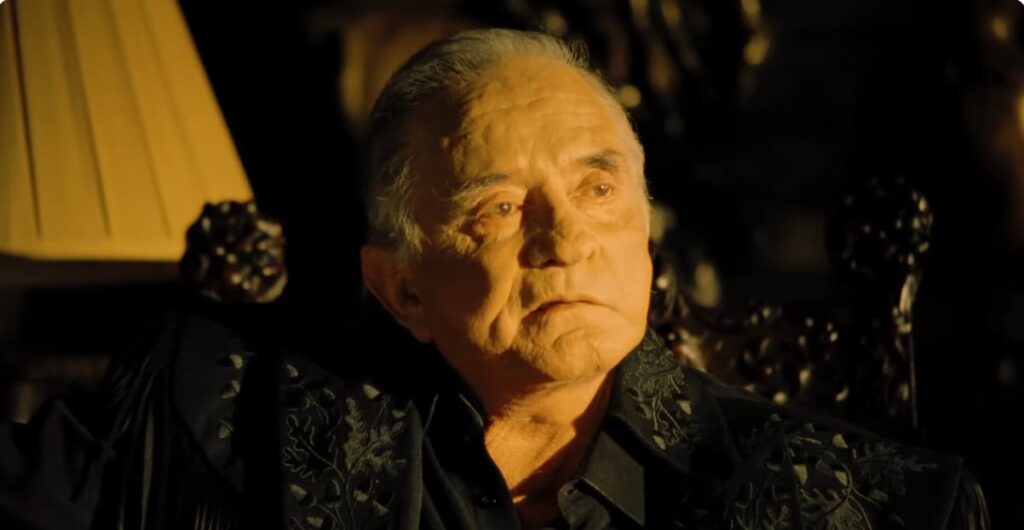
When a Legend Faces the End: The Four Minutes That Turned Hurt Into a Final Confession
In an era dominated by spectacle and perfection, a fragile, aging man sat before a camera and delivered one of the most devastating performances ever captured on film. The video for “Hurt,” performed by Johnny Cash, is not simply a music release. It is a moment where art, memory, and mortality collide with unsettling honesty.
Originally written by Nine Inch Nails, the song explored themes of self destruction and inner conflict. Yet in Cash’s hands, it becomes something far more profound. The lyrics no longer belong to youth or rebellion. They are reframed as the reflections of a man nearing the end of his life, looking back on decades marked by fame, loss, and personal struggle.
Directed by Mark Romanek, the video abandons traditional performance aesthetics in favor of stark realism. Filmed largely inside Cash’s own home, it presents an intimate portrait that feels closer to a private diary than a public production. The camera lingers on his weathered face, capturing every tremor in his voice, every pause that suggests more than words can express.
One of the most striking elements lies in its visual symbolism. Decaying fruit, fading flowers, and abandoned spaces serve as quiet metaphors for the passage of time and the erosion of both body and legacy. Intercut with archival footage of Cash in his prime, the video constructs a powerful contrast between past glory and present vulnerability. This juxtaposition transforms the piece into a visual meditation on what remains when the spotlight fades.
The presence of June Carter Cash adds another layer of emotional gravity. Her brief appearance, filled with silent understanding, underscores the personal dimension of the performance. Knowing that both would pass away not long after the video’s release deepens its resonance, turning it into an unintended farewell.
Perhaps the most haunting moment arrives at the end, when Cash gently closes the lid of a piano. It is a simple gesture, yet it carries the weight of finality, as if signaling the end of a life’s work. There is no dramatic flourish, no attempt to soften the impact. Only quiet acceptance.
More than two decades later, “Hurt” continues to captivate audiences not because of technical brilliance, but because of its truth. It stands as a rare instance where a performer does not hide behind the music, but instead becomes inseparable from it. In doing so, Johnny Cash did not just reinterpret a song. He transformed it into a lasting testament of what it means to confront one’s own legacy.