
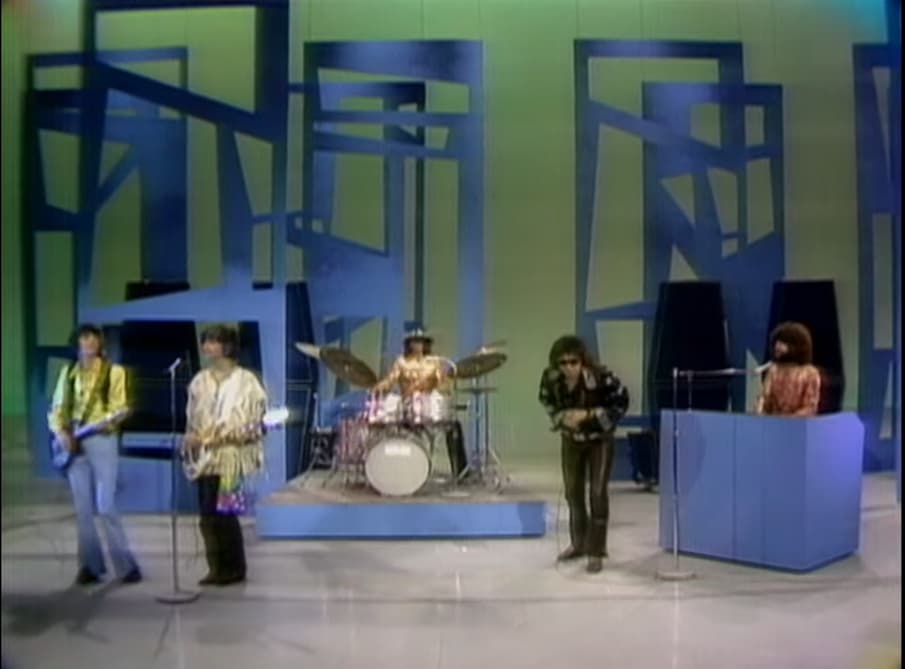
A Call for Change on National Television: Steppenwolf Perform “It’s Never Too Late” in 1969
On May 19, 1969, Steppenwolf appeared on The Ed Sullivan Show, delivering a performance of “It’s Never Too Late” that captured both the band’s rising influence and the broader cultural climate of the late nineteen sixties. At a time when rock music was expanding beyond entertainment into social commentary, this appearance placed a powerful message directly into the homes of a mainstream audience.
The significance of the setting cannot be overstated. The Ed Sullivan Show had already introduced major acts such as The Beatles to American viewers, serving as a gateway between emerging musical movements and mass media. For Steppenwolf, whose sound was rooted in a more direct and forceful style of rock, this platform represented both opportunity and contrast. Their music, often associated with raw energy and a sense of independence, entered a highly structured broadcast environment that required clarity and restraint.
“It’s Never Too Late” aligns closely with the social atmosphere of its time. The late nineteen sixties were marked by political unrest, generational change, and a growing desire for transformation. The song’s message, centered on the possibility of change and personal awakening, resonated beyond its immediate musical context. In a televised performance, this message gained additional reach, extending from the stage to a diverse national audience.
From the opening moments, the band establishes a direct and purposeful tone. There is no elaborate introduction, only a clear entry into the song’s rhythm and structure. This approach reflects Steppenwolf’s broader aesthetic, where impact is achieved through simplicity and conviction rather than complexity. At the center of the performance is John Kay, whose vocal delivery carries a sense of urgency that reinforces the song’s thematic intent.
The arrangement remains focused throughout, shaped in part by the limitations of television format. Without extended instrumental passages or improvisation, the band presents a concise version of the track that emphasizes its core elements. This adaptation demonstrates how rock artists of the era navigated the demands of broadcast media while maintaining their identity.
The performance concludes with a controlled and decisive ending, consistent with the structure of the program. While brief, the presentation leaves a lasting impression, highlighting the balance between message and medium.
Viewed today, this recording offers insight into a moment when rock music began to engage directly with wider audiences through television. It captures Steppenwolf at a point where their sound and message intersected with a changing cultural landscape, illustrating how a single performance could reflect both artistic intent and historical context.