
A Band Ends, A Voice Continues: John Kay Steps Forward in 1972
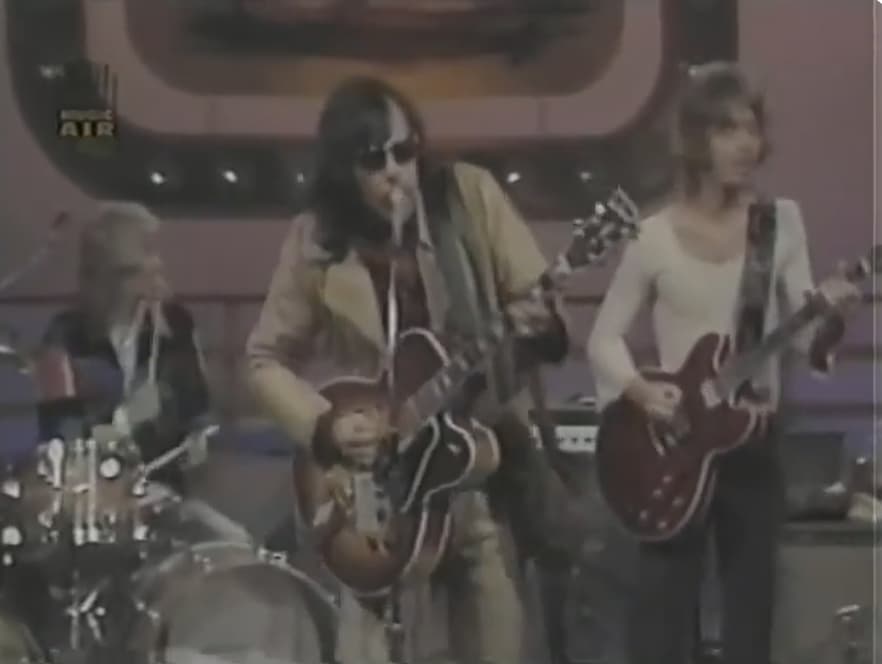
In 1972, a year marked by transition and uncertainty, John Kay appeared on the television program “Rollin’ On The River” with a performance that quietly captured a turning point in rock history. Delivering a compelling rendition of “I’m Movin’ On,” Kay stood before audiences not as the frontman of Steppenwolf, but as the leader of a new musical chapter that still carried the unmistakable spirit of his past.
The context surrounding this appearance gives the performance its deeper significance. Earlier that same year, Steppenwolf had officially disbanded, closing a defining era for one of the most recognizable rock acts of the late 1960s and early 1970s. Yet the separation was not as clear cut as it seemed. Kay’s backing group included familiar figures such as George Biondo and Kent Henry, both of whom had been part of the band’s final lineup. Their presence blurred the line between past and present, creating a sound that felt less like a departure and more like a continuation under a different name.
“I’m Movin’ On” proved to be a fitting choice for this moment. The song’s theme of moving forward resonated strongly with Kay’s personal and professional situation. Without the need for explanation, the performance itself became a statement of intent. Kay was not attempting to recreate Steppenwolf’s identity, but neither was he abandoning it. Instead, he carried its core elements into a new setting, allowing the music to evolve while remaining grounded in its origins.
The television setting added another layer of interest. Programs like “Rollin’ On The River” offered artists a platform to reach wide audiences at a time when live broadcasts played a central role in shaping musical perception. This appearance provided viewers with a rare opportunity to witness an artist in transition in real time. There was no distance, no reinvention carefully staged over years. What unfolded was immediate and authentic.
Musically, the performance retained the raw, driving energy associated with Kay’s earlier work, yet it also revealed a subtle shift. The arrangement felt more open, less bound to the expectations attached to a major band identity. This flexibility allowed Kay to explore his role not just as a frontman, but as an artist redefining his direction.
Looking back, the 1972 performance stands as more than a routine television appearance. It represents a moment when endings and beginnings coexisted on the same stage. In singing “I’m Movin’ On,” John Kay was not only performing a song. He was documenting a personal evolution, one that continues to resonate as a testament to resilience and artistic continuity.