
Six Months to Live, Five Years to Tell the Story: Noddy Holder’s Remarkable Fight Back
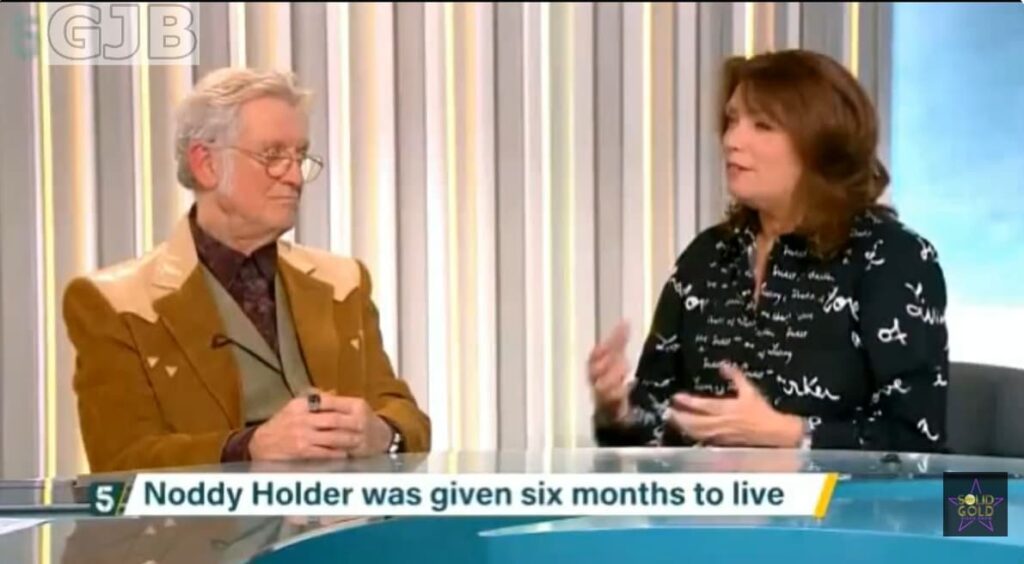
In a candid appearance on Channel 5 News, Noddy Holder shared a deeply personal account that reaches far beyond music. Best known as the unmistakable voice of Slade, Holder revealed that he had once been given just six months to live after being diagnosed with esophageal cancer. Today, more than five years later, he speaks not as a patient defined by illness, but as a survivor shaped by resilience and perspective.
The diagnosis came unexpectedly during a routine medical check. What began as a standard examination led to the discovery of a significant growth in his esophagus. The prognosis was stark. Doctors believed there was no cure and offered a limited timeframe. Faced with that reality, Holder made a decision that would define the next chapter of his life. He agreed to undergo an experimental chemotherapy treatment, a course rarely administered to someone of his age at the time. With little to lose, he chose to proceed.
The treatment was demanding, both physically and emotionally. Holder acknowledged the difficulty of the process, yet maintained a composed and pragmatic outlook. He described approaching each day as it came, a philosophy that had guided him since childhood. This mindset, combined with medical intervention, proved decisive. Against expectations, his condition improved, allowing him to gradually regain strength and return to aspects of his former life.
His wife, Susan Holder, provided insight into the emotional toll behind the scenes. The couple chose to keep the diagnosis private for several years, sharing the news only with close family and friends. She recalled the shock of hearing the initial prognosis and the challenge of coping with uncertainty. Their decision to speak publicly now is rooted in a desire to offer encouragement to others facing similar circumstances.
There is a notable shift in Holder’s relationship with performance. Having spent decades on stage, he now approaches it with caution and gratitude. A recent return to live appearances alongside Tom Seals marked a symbolic moment, not as a full scale comeback, but as a celebration of continued life. The stage, once routine, has become something to approach with care.
As the festive season approaches, Holder reflects on traditions that have taken on new meaning. Known for a song that has become synonymous with Christmas, he now views such moments through a more personal lens, centered on family and presence rather than performance.
This account is not framed as a miracle, but as a convergence of determination, medical science, and perspective. In sharing his experience, Noddy Holder offers more than a story of survival. He presents a reminder that even in the face of the most severe prognosis, the outcome is not always fixed, and that hope, when grounded in reality, can be a powerful force.