
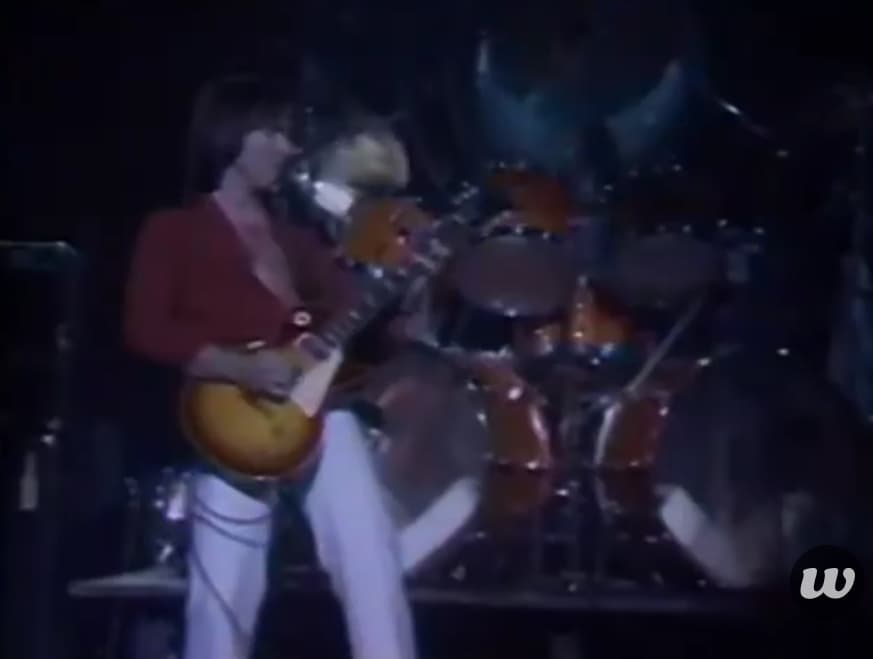
“Open Fire” as a Turning Point in Live Rock Performance
On April 3, 1978, a stage in New York City became the setting for a quiet but significant shift in rock music. Ronnie Montrose, already respected for his earlier work in hard rock, stepped into a new artistic identity with a live performance centered around “Open Fire.” What unfolded was not merely a concert, but a deliberate move away from the expectations that had defined his previous success.
By this point, Montrose had moved beyond the structure of a traditional band format. The absence of a lead vocalist immediately changed the dynamic of the performance. Instead of lyrics guiding the audience, the guitar assumed a narrative role, shaping mood and direction through tone and phrasing. This shift required a different kind of attention from listeners, one that rewarded patience and immersion rather than familiarity.
The performance itself reveals an artist exploring new territory with confidence. Opening passages establish an atmosphere that feels closer to composition than standard rock arrangement. There is a sense of space in the music, allowing each note to resonate with intention. As the set progresses, transitions between heavier rock segments and more fluid, jazz influenced passages create a layered listening experience that avoids predictability.
One of the most compelling aspects of the show lies in its emotional undercurrent. Without words, Montrose communicates through subtle variations in dynamics and tempo. The guitar lines do not simply demonstrate technical skill. They suggest movement, tension, and release, offering a form of storytelling that is both abstract and deeply expressive. In this context, “Open Fire” becomes more than a title. It functions as a statement of artistic freedom, reflecting a willingness to explore without limitation.
The closing moments of the performance reinforce this idea. Rather than delivering a conventional ending, the music leaves a sense of continuation, as if the journey extends beyond the stage. This approach aligns with Montrose’s broader transition at the time, moving toward a career defined less by commercial expectations and more by personal exploration.
Viewed today, the New York performance stands as a valuable document of transformation. It captures a musician at a point where risk and creativity intersect, resulting in a work that challenges traditional definitions of rock performance. In choosing to let the guitar speak alone, Ronnie Montrose did not simplify his music. He expanded its possibilities.