
A Quiet Truth on Stage: Kenny Rogers and Dolly Parton’s “Real Love” Still Speaks Across Decades
In an era often defined by spectacle, a rediscovered live clip of Kenny Rogers and Dolly Parton performing Real Love offers something strikingly different: restraint, sincerity, and a connection that refuses to fade.
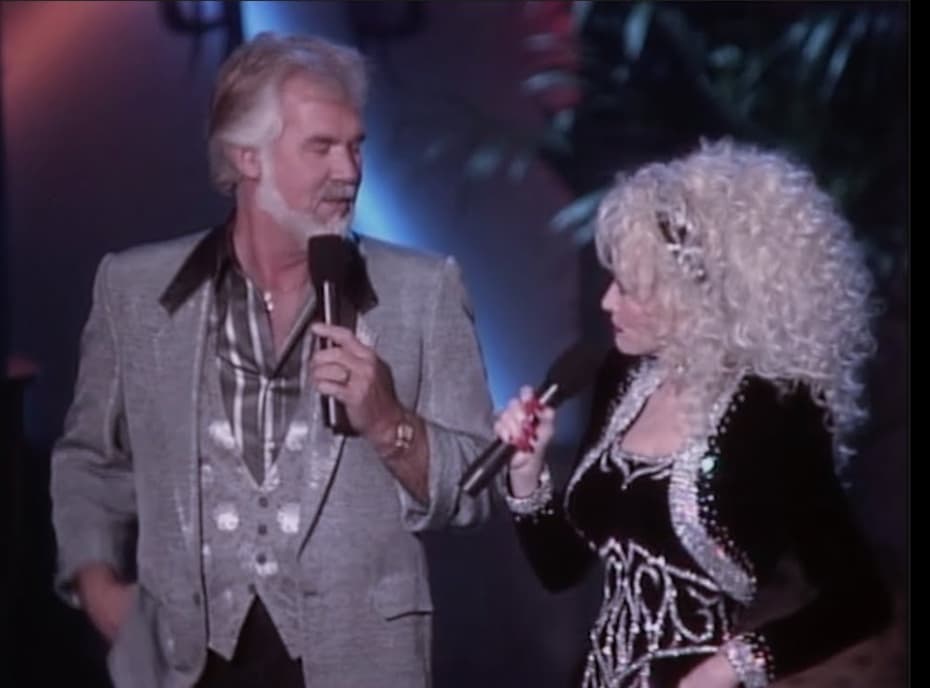
The performance traces back to the 1985 HBO television special built around their joint project, a production shaped from a multi-city U.S. tour. Rather than presenting a single-night concert, the special stitches together moments across several stages, creating a narrative that feels both intimate and expansive. The result is not merely a live rendition, but a curated emotional document of two artists at a unique point in their careers.
“Real Love” arrived in the long shadow of their global hit “Islands in the Stream,” yet it deliberately turns away from pop exuberance. The song leans into maturity, choosing subtlety over scale. That artistic decision becomes even more visible on stage. There is no dramatic build, no vocal competition, no attempt to dominate the moment. Instead, Rogers and Parton share space with quiet confidence, allowing pauses and glances to carry as much weight as the lyrics themselves.
What captures attention most is the chemistry that resists easy definition. The pair maintain a physical distance, rarely leaning into overt gestures. Yet their focus remains locked, their timing instinctive. It suggests a bond grounded in trust rather than performance. This nuance reflects a well-known aspect of their offstage relationship: a deep, enduring friendship that never crossed into romance, despite years of public speculation.
That context adds an additional layer of meaning. A song titled “Real Love” becomes less about romantic declaration and more about emotional authenticity in all its forms. The stage, in this sense, mirrors reality. The audience witnesses not a fictional narrative, but an echo of something lived and understood between two people who shared decades of collaboration.
Today, the circulating clip is often incomplete, trimmed for copyright or reshaped by fans. Even in fragments, its impact remains intact. Viewers are drawn not by technical brilliance, but by a rare sense of honesty. It feels unforced, almost conversational, as though the music exists simply to hold a moment in place.
In a fast-moving digital landscape, this performance stands as a reminder that not every lasting impression requires volume. Sometimes, it is the quiet exchange between two voices that endures the longest.