
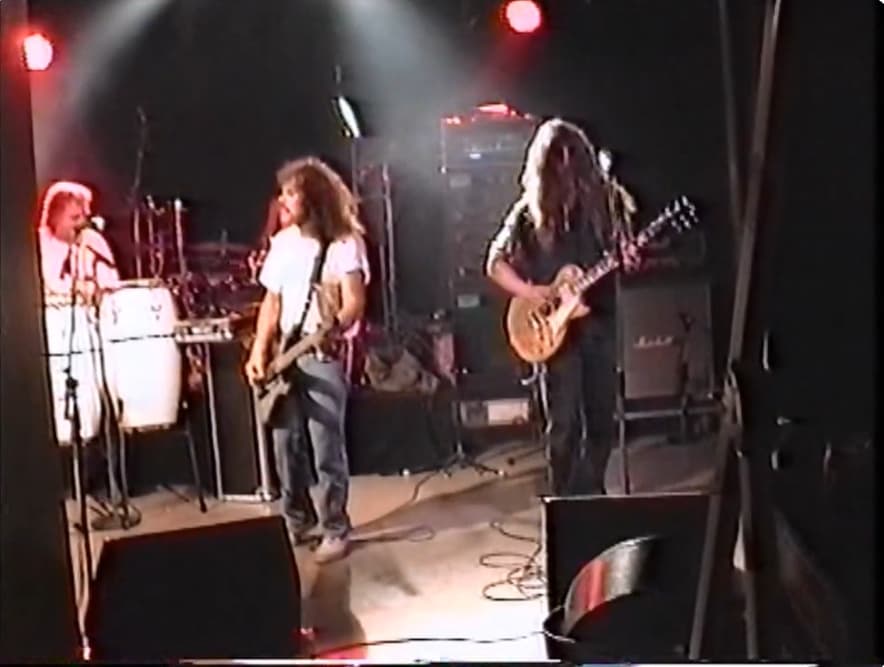
When the Groove Comes Home: A Quiet Rehearsal Revives the True Spirit of Status Quo
In a modest rehearsal setting far removed from stadium lights and roaring crowds, a remarkable moment of rock history quietly unfolds. The performance of “Big Fat Mama” by Alan Lancaster alongside John Coghlan, joined by The Bombers, offers something far more revealing than a polished concert. It captures the essence of a sound that once defined an era and still resonates with striking authenticity.
For longtime followers of Status Quo, this rehearsal carries a significance that goes beyond the music itself. Lancaster and Coghlan formed the rhythmic backbone of the band during its most celebrated years in the early 1970s, a period when their signature boogie rock style reached its full power. Though both musicians eventually parted ways with the group, their musical connection never fully disappeared. Here, in this unguarded setting, it returns with effortless precision.
“Big Fat Mama,” originally released on the album Piledriver in 1972, serves as the perfect vehicle for this reunion of spirit. The track has long been recognized as one of the defining examples of Status Quo’s driving, no frills approach to rock. In this rehearsal, however, it takes on an added dimension. It becomes less about revisiting a classic and more about rediscovering a shared language that time has not erased.
What makes this footage particularly compelling is its lack of spectacle. There is no elaborate staging, no attempt to recreate past glory. Instead, the focus rests entirely on the interplay between bass and drums, the tight rhythmic pulse that once powered countless performances. Lancaster’s bass lines remain firm and grounded, while Coghlan’s drumming carries the familiar swing that defined the band’s early recordings. Together, they recreate a groove that feels both immediate and deeply rooted in memory.
There is also an undeniable sense of reflection woven into the performance. By the time this rehearsal took place, decades had passed since the height of Status Quo’s commercial success. Yet the passage of time seems irrelevant once the music begins. The chemistry is intact, the timing instinctive. It suggests that certain musical bonds do not fade but simply wait for the right moment to resurface.
For audiences today, the clip offers more than nostalgia. It invites a reassessment of what made Status Quo distinctive in the first place. Was it the lineup, the songwriting, or the unique rhythmic engine created by musicians like Lancaster and Coghlan. The answer may lie in moments like this, where the past is not recreated but quietly lived again.
In the end, this rehearsal stands as a testament to endurance. Not of fame or image, but of feel. The groove, once established, never truly disappears.