
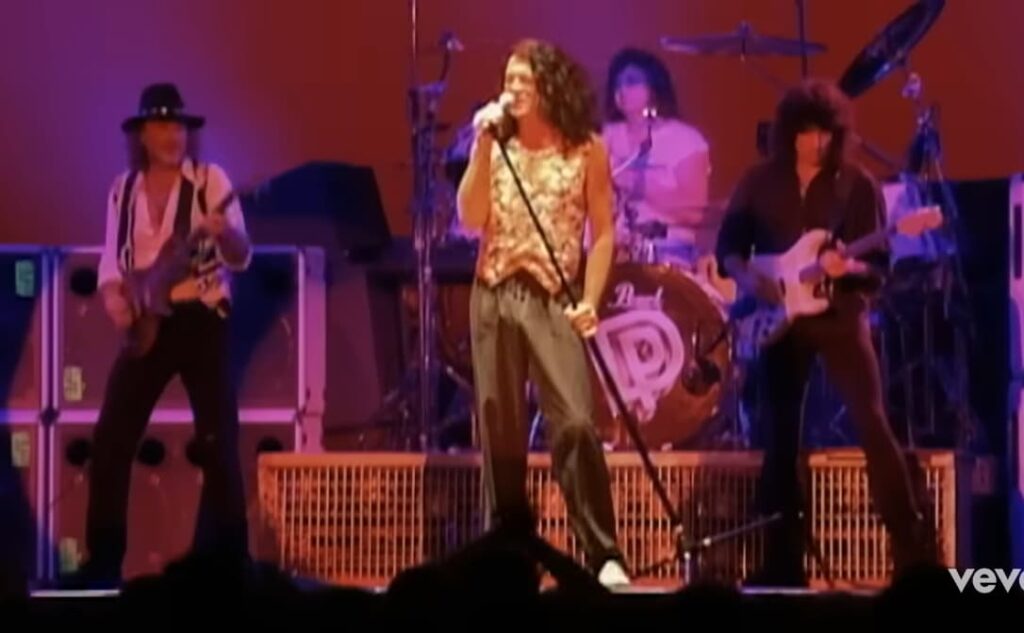
Legends Drift Apart: Deep Purple’s “Perfect Strangers” Reveals a Band at the Edge of Change
There are performances that celebrate unity, and then there are those that quietly expose its absence. The live rendition of “Perfect Strangers” from Come Hell or High Water captures Deep Purple at a moment when legacy and tension coexist in equal measure. For longtime listeners, it is both a powerful reminder of greatness and a candid glimpse into a band approaching a turning point.
At the center of attention stands Ritchie Blackmore, whose presence during this period has become the subject of enduring debate. Reports from the tour suggest a musician increasingly disengaged, at times appearing distant from the collective energy on stage. Yet what makes the performance compelling is the contrast between perception and execution. Even in moments of apparent detachment, Blackmore’s tone remains unmistakable, his phrasing precise and expressive. It is a reminder that technical brilliance can persist even when emotional alignment begins to fade.
The song itself adds a layer of irony that is difficult to ignore. “Perfect Strangers” speaks of familiarity lost, of connections that have become distant despite shared history. In this performance, that theme seems to mirror the internal dynamics of the band. Members who once defined a genre together now appear to occupy separate creative spaces, bound by professionalism but lacking the seamless cohesion of earlier years. It is this tension that gives the performance its unique emotional weight.
Vocalist Ian Gillan delivers a steady and controlled performance, maintaining clarity and presence throughout. Alongside him, Jon Lord provides the rich harmonic foundation that has long distinguished Deep Purple’s sound. The rhythm section, anchored by Roger Glover and Ian Paice, continues to operate with precision, ensuring that the structure of the song remains intact even as the emotional dynamics shift.
For audiences who discovered the band decades earlier, this performance carries a strong sense of reflection. It evokes memories of an era when Deep Purple stood at the forefront of hard rock innovation, shaping a sound that would influence generations. Watching them here, there is admiration for their enduring skill, but also an awareness that something intangible has changed.
Historically, the performance gains further significance as it precedes Blackmore’s departure from the band in the early 1990s. In that sense, it can be viewed as part of the closing chapter of a defining lineup. The music continues, the notes are played, yet the atmosphere suggests an ending already in motion.
This recording invites a broader question that continues to resonate among fans. Can a band remain truly unified once its internal chemistry begins to shift, or does the music inevitably reflect those fractures. In the case of Deep Purple, the answer is preserved within this performance. It is both a testament to their greatness and a portrait of a moment when even legends could become, in their own way, strangers to one another.
 Oldies Songs