
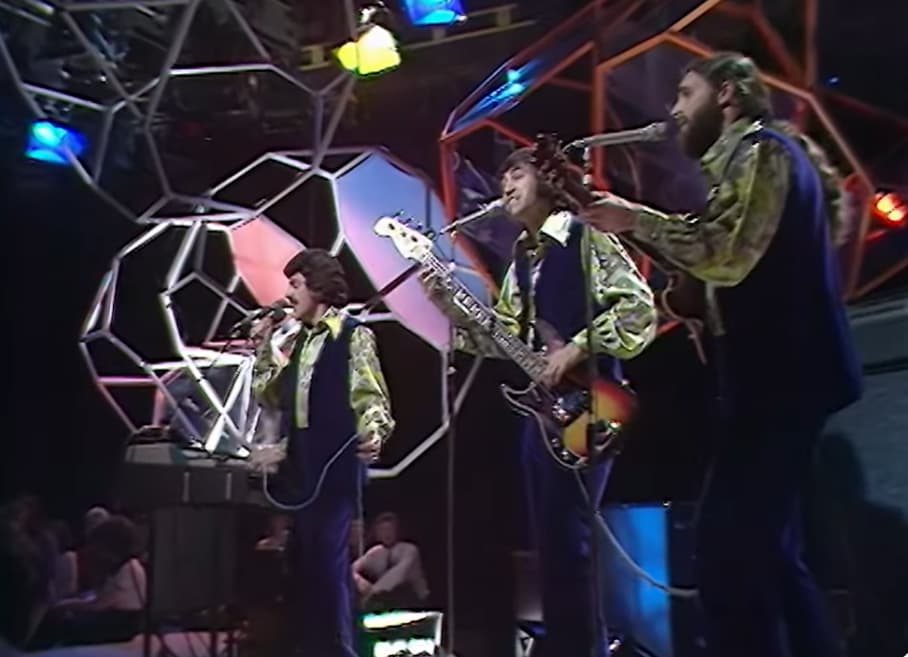
Four Songs, One Voice, A Lasting Spell: Frankie Valli Turns Television Into a Time Capsule
A brief television appearance in February 1971 captured a remarkable moment for Frankie Valli & The Four Seasons as they delivered a tightly arranged medley on Top of the Pops. In a matter of minutes, the group revisited a string of defining hits and reminded British audiences why their sound had traveled so effectively across borders and eras.
The selection moved seamlessly through “Sherry,” “Big Girls Don’t Cry,” “Walk Like A Man,” and “Bye Bye Baby,” each song representing a distinct chapter in the group’s rise. Rather than feeling condensed, the medley gained momentum with each transition. The structure allowed viewers to experience a condensed narrative of success, where melody and memory intertwined without losing clarity or impact.
At the center stood Frankie Valli, whose falsetto remained as striking as ever. His voice, instantly recognizable, carried both precision and emotional lift. Even within the constraints of a television studio, he projected a sense of scale that extended beyond the frame. There was no visible strain, only control and familiarity, suggesting a performer fully at ease with material that had already entered the cultural bloodstream.
Supporting him, Bob Gaudio, Joe Long, and Bob Grim provided the vocal and instrumental foundation that defined the group’s signature harmony. Their cohesion underscored an important truth about the Four Seasons. While Valli’s voice often draws primary attention, the collective precision of the group is what gives the music its enduring structure and richness.
The setting itself adds an additional layer of significance. Top of the Pops functioned as a cultural gatekeeper in the United Kingdom, shaping public taste and elevating artists to new audiences. By 1971, the group’s commercial peak in the United States had softened, yet their reception in Britain remained strong. This performance reflects that dynamic, illustrating how music can find renewed life in different contexts.
There is also a broader sense of nostalgia embedded in the medley. Songs that first resonated in the early 1960s are presented here with freshness, proving their resilience against shifting trends. The absence of elaborate staging places full emphasis on melody, harmony, and delivery, elements that remain timeless.
Viewed today, the performance stands as more than a television segment. It becomes a compact archive of pop history, demonstrating how a single voice and a unified group can carry an entire era forward.
 Great Songs