
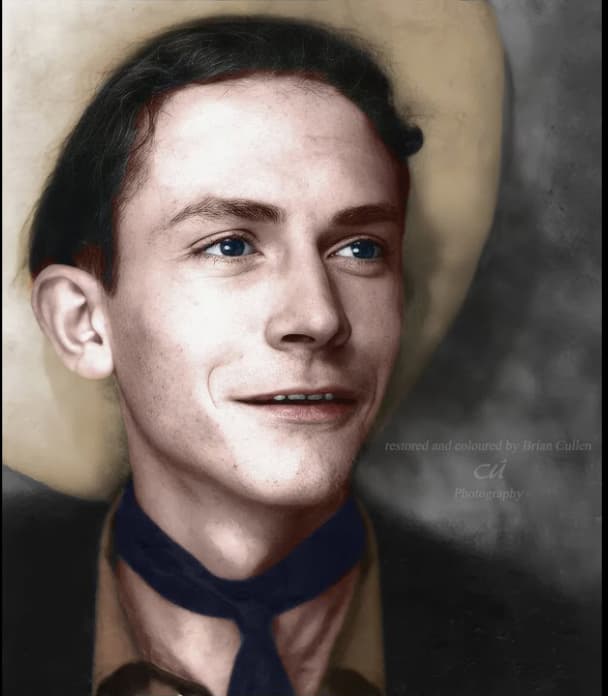
He Was Already Breaking: The Night Hank Williams Turned “Cold, Cold Heart” Into a Confession
There are performances that entertain, and then there are moments that quietly expose a life unraveling. The televised rendition of Cold, Cold Heart by Hank Williams belongs firmly to the latter. It does not announce itself as historic. It simply unfolds with a stillness that feels almost unsettling.
At first glance, nothing about the setting suggests significance. The stage is bare. The arrangement is restrained. There is no attempt to elevate the moment through spectacle. Yet within seconds, it becomes clear that something far more compelling is taking place. Williams does not perform the song so much as inhabit it. His posture is rigid, his delivery measured, and his presence carries a weight that cannot be rehearsed.
What defines the performance is its emotional transparency. His voice, fragile and unpolished, refuses to hide behind technique. Each line feels lived in rather than projected. Instead of reaching outward to the audience, he seems turned inward, as though the act of singing is less about communication and more about survival. The camera captures this tension without interruption, allowing viewers to witness a man navigating something deeply personal in real time.
The narrative of the song amplifies this effect. “Cold, Cold Heart” is not a conventional tale of heartbreak. It is a study of emotional distance shaped by past wounds. The central conflict is not betrayal in the present, but damage carried over from the past. Love is not absent, but it is rendered ineffective. This distinction gives the performance its quiet devastation. Williams is not pleading for affection. He is confronting the reality that affection may no longer be enough.
Offstage, the parallels are difficult to ignore. His turbulent relationship with Audrey Williams had already become a defining element of his personal life. Reports of conflict and instability surrounded their marriage, lending the song an autobiographical edge that audiences could sense, even if they did not fully understand it. In this light, the performance feels less like interpretation and more like revelation.
There is also a striking irony embedded in the moment. By this point, Williams had achieved significant commercial success. His music was reaching a wide audience, and his influence was growing rapidly. Yet none of that success is visible here. What the audience sees instead is a man stripped of control, confronting emotions that fame cannot resolve.
The closing moments offer no release. There is no dramatic flourish, no attempt to resolve the tension. The song ends as it began, suspended in quiet resignation. It is this refusal to provide closure that gives the performance its lasting power.
Decades later, the clip endures not because it is flawless, but because it is unguarded. It captures a rare intersection where artist and reality become indistinguishable, leaving behind a performance that feels less like history and more like a moment still happening.