
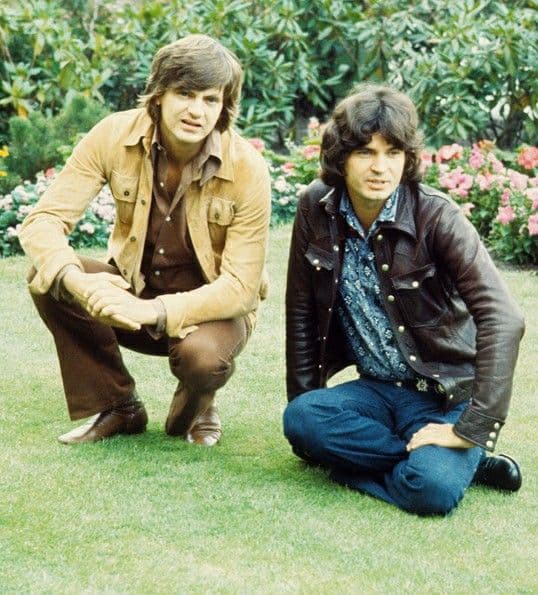
From Chart Topping Innocence to Living Legacy A Television Moment That Still Glows
On a late summer night in 1972, viewers of The Midnight Special witnessed something far more enduring than a routine performance. The Everly Brothers stepped into the soft glow of television lights to perform “All I Have to Do Is Dream,” a song that had already secured its place in music history more than a decade earlier. What unfolded was not simply a revival, but a quiet reaffirmation of why certain melodies never lose their emotional gravity.
First released in 1958, the composition written by Felice Bryant and Boudleaux Bryant achieved a rare feat by reaching number one across multiple Billboard charts, a testament to its universal appeal. Yet in this 1972 television appearance, the song revealed a different dimension. Time had subtly reshaped the voices of Don and Phil Everly, lending a maturity that deepened the song’s central idea of longing sustained through imagination.
The performance itself embraced restraint. There was no elaborate staging, no attempt to compete with spectacle. Instead, the focus rested entirely on the brothers’ signature close harmony, a vocal interplay that has influenced generations of artists from The Beatles to Simon & Garfunkel. Each phrase unfolded with a sense of ease that belied its technical precision, reminding audiences that simplicity, when executed at the highest level, can carry extraordinary emotional weight.
What made the moment particularly compelling was the contrast between past and present. In 1958, the song captured youthful idealism, presenting love as something effortlessly reachable through dreams. By 1972, that same sentiment carried a more reflective tone. The lyrics, unchanged, seemed to resonate differently when delivered by artists who had lived through the very passage of time their audience now felt.
For many viewers, the broadcast functioned as a bridge between eras. It offered a chance to reconnect with a period when melody and harmony stood at the center of popular music. For younger audiences discovering the song for the first time, it served as an introduction to a standard that continues to define vocal excellence.
Debate often surrounds whether the original recording or later performances hold greater emotional power. The studio version remains pristine, almost untouchable in its clarity. Yet performances like this one suggest that songs can evolve alongside their interpreters, gaining nuance rather than losing it.
In the end, “All I Have to Do Is Dream” endures because it speaks to something fundamentally human. It acknowledges that not all desires can be fulfilled in reality, yet offers a gentle consolation. Sometimes, the act of dreaming is enough.