
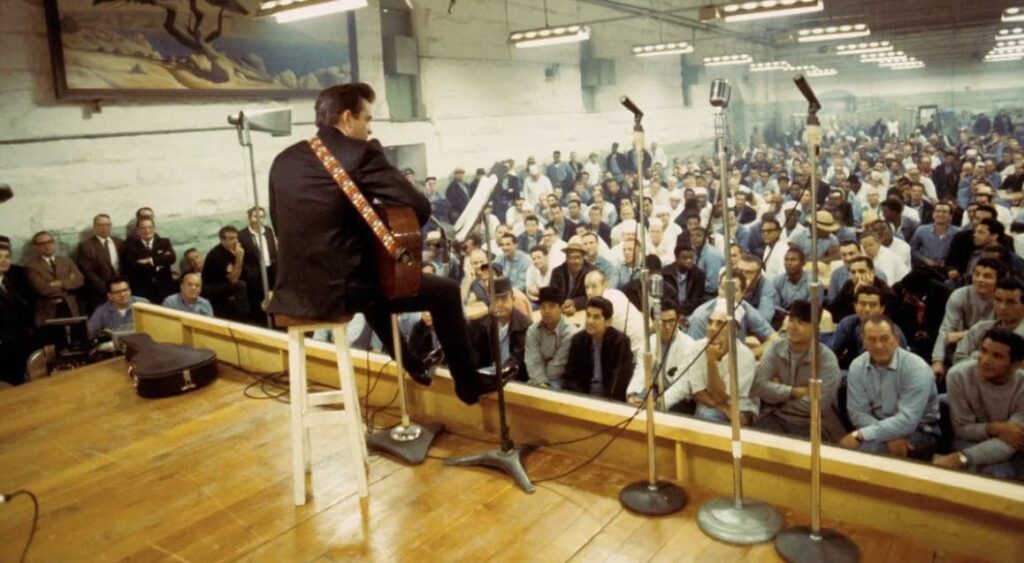
Inside Folsom: The Day Johnny Cash Turned a Prison Performance into Music History
In January 1968, Johnny Cash walked into Folsom State Prison with more at stake than a typical live show. His career had been faltering, his health and personal struggles well known, and the music industry was no longer certain of his place. What followed inside those prison walls would not only revive his career but redefine the emotional power of live performance in American music.
The song at the center of this moment, Folsom Prison Blues, had been written more than a decade earlier. Cash had never served time in prison, yet he crafted lyrics that captured the stark psychology of confinement with unsettling precision. The now famous line about shooting a man in Reno was deliberately written to express senseless violence, stripping away justification and forcing listeners to confront the emptiness behind the act. That choice would later take on a different weight when performed in front of men who understood consequences firsthand.
The performance itself was marked by an immediacy rarely captured on record. Cash opened with his now iconic introduction and moved directly into the song, creating a sense of urgency that resonated throughout the room. The audience, composed entirely of inmates, responded with a mixture of restraint and intensity. Their reactions were shaped not only by the music but by the environment, where even expressions of enthusiasm carried unspoken limits. Yet within those boundaries, a powerful connection formed.
What made this moment extraordinary was the alignment between narrative and reality. A song written from the perspective of a prisoner was now being delivered to those living that reality. Cash was no longer just a performer. He became a conduit, translating emotion into sound in a way that felt authentic to both sides of the bars. It was this authenticity that elevated the performance beyond entertainment.
The recording, drawn from multiple sets performed that day, would go on to become one of the most celebrated live albums in country music. More importantly, it marked a turning point in Cash’s life. The man who had once stood on the edge of irrelevance emerged with renewed purpose, embraced not only by fans but by those who saw in his music a reflection of their own stories.
Decades later, the performance endures not simply because of its historical significance, but because of its emotional truth. In that prison hall, music did more than fill the silence. It revealed it.