
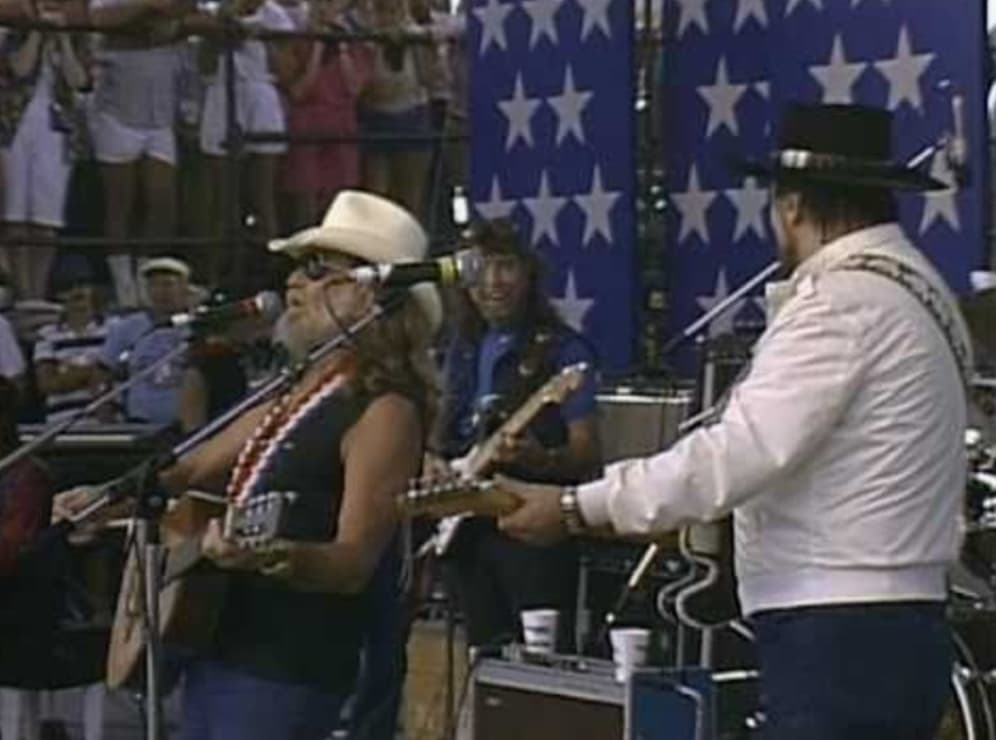
Where Outlaw Voices Met the People They Sang About
The performance of Mammas Don’t Let Your Babies Grow Up to Be Cowboys by Willie Nelson and Waylon Jennings at Farm Aid 1986 stands as more than a musical moment. It captures a rare intersection between art and reality, where a song about distance, loneliness, and hard living was delivered directly to those who embodied it.
Farm Aid itself carried a purpose far deeper than entertainment. Created to support struggling American farmers, the event gathered voices that represented working class life. Nelson and Jennings did not arrive as polished performers separated from their audience. They stepped onto the stage as figures who had long defined the outlaw country movement, a genre built on resisting commercial expectations and speaking uncomfortable truths.
What made this particular performance striking was its honesty. There was no dramatic opening, no elaborate arrangement, and no attempt to elevate the moment into spectacle. The delivery felt unfiltered. Nelson’s phrasing drifted slightly off the expected rhythm, while Jennings grounded the song with a steady, rugged presence. Instead of weakening the performance, these imperfections reinforced its authenticity. The song did not feel performed. It felt lived.
The deeper resonance lies in the contrast between message and setting. The lyrics caution against the cowboy life, describing isolation and emotional distance. Yet here, the song was offered to farmers whose lives mirrored that same hardship. In this context, the meaning subtly shifted. It no longer sounded like a warning alone. It became a form of recognition, even quiet respect.
There was also a cultural weight surrounding the moment. By the mid eighties, country music was gradually moving toward a more refined and commercial sound. This performance preserved a different spirit, one rooted in simplicity, directness, and emotional truth. The stripped down staging and casual appearance of the artists reflected a world that was beginning to fade from the mainstream.
The closing carried no grand finale. There was no surge of theatrical energy, no climactic vocal display. Instead, the song ended in the same understated tone with which it began. That choice echoed the reality it portrayed. Lives like those of cowboys or farmers do not resolve in dramatic peaks. They continue, quietly and persistently.
In retrospect, the performance endures because it refuses to exaggerate. It presents a moment where music aligns completely with lived experience. For many, that alignment is what transforms a familiar song into something lasting.