
A Voice That Redefined Tenderness: Linda Ronstadt and the Quiet Power of “Different Drum”
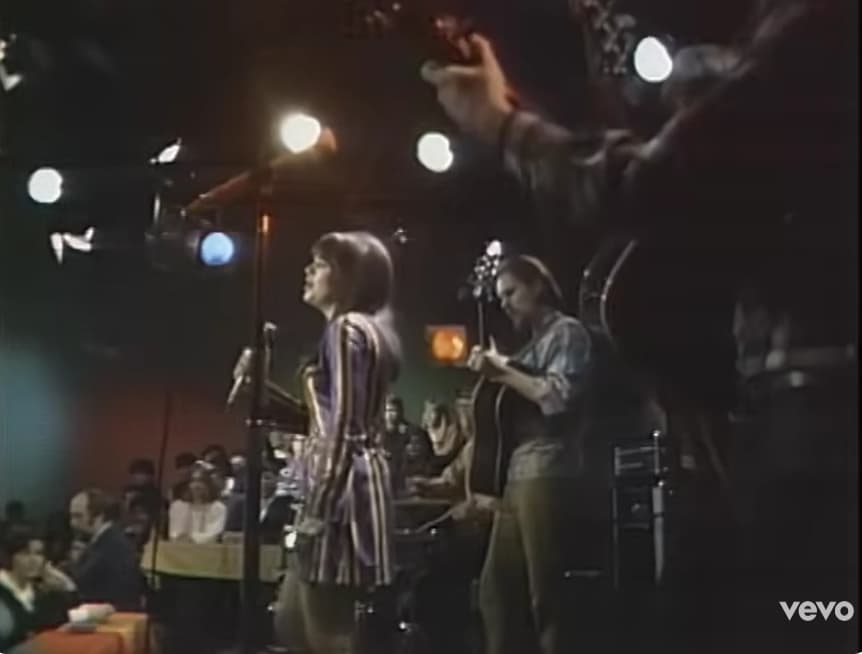
It is easy to describe a performance as beautiful. It is far more difficult to explain why certain voices seem to alter the emotional temperature of a room within seconds. In this rare live rendition of “Different Drum” by The Stone Poneys, fronted by Linda Ronstadt, what emerges is not just a song, but a defining moment in the evolution of modern vocal interpretation.
Written by Mike Nesmith of The Monkees, “Different Drum” was initially deemed unsuitable for the band that commissioned it. That decision, in retrospect, appears almost historic in its miscalculation. When Ronstadt took ownership of the song, she did not simply perform it. She reshaped its emotional architecture. What might have been a pleasant pop tune became something far more intimate and quietly devastating.
The performance itself reflects a transitional era in American music. The late 1960s were saturated with experimentation, yet this recording shows restraint rather than excess. The arrangement remains delicate, allowing space for Ronstadt’s phrasing to carry the weight. Each note feels considered, never forced. Her voice moves with a kind of natural clarity that resists theatrical exaggeration, and that restraint becomes its greatest strength.
Observers often point to one particular vocal moment near the song’s emotional peak as something close to perfection. It is not technically overwhelming, nor is it designed to impress through power. Instead, it communicates vulnerability with precision. That is the distinction that separates Ronstadt from many of her contemporaries. She does not aim to dominate the song. She inhabits it.
There is also an understated chemistry within the band. The Stone Poneys do not compete for attention. Their role is supportive, almost selfless, reinforcing the idea that this performance is about collective sensitivity rather than individual display. Even the inclusion of additional instrumentation, such as the presence of a jazz harp, adds texture without disrupting the song’s fragile balance.
For audiences revisiting this footage today, the experience often carries a sense of quiet disbelief. Not because the performance is flashy, but because it feels so complete. In an era where vocal performances are frequently shaped by production and digital refinement, this stands as a reminder of what unembellished musical expression can achieve.
“Different Drum” ultimately became a defining moment for Ronstadt’s early career, and this live version helps explain why. It captures an artist at the precise point where instinct, material, and emotional clarity align. That kind of alignment is rare, and when it happens, it does not need to announce itself loudly.
It simply stays with you.