
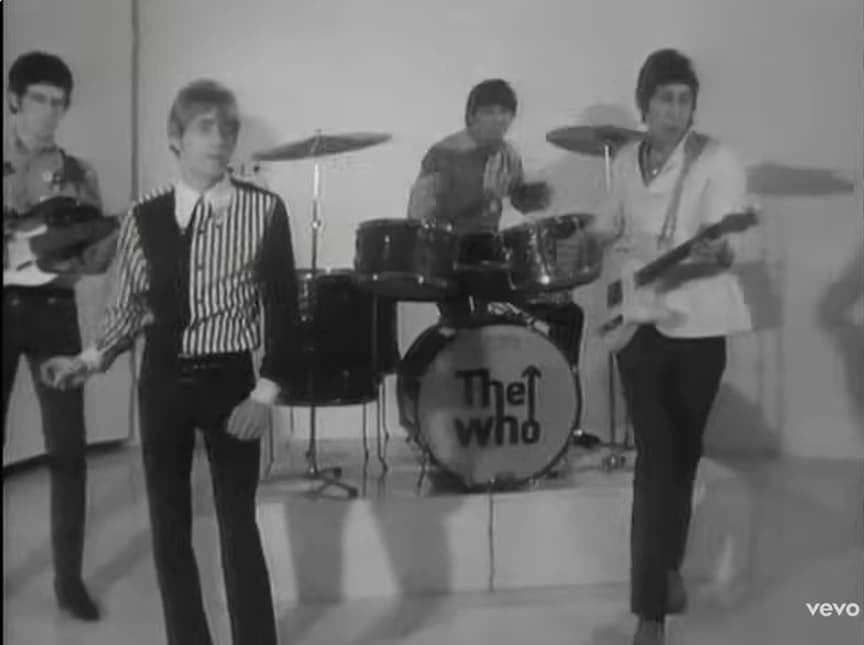
Chaos, Precision, and Attitude: The Who Turn “Substitute” into a Statement of Identity
In the late 1960s, few bands understood the theatrical and musical tension of live performance better than The Who. Their rendition of “Substitute,” captured during the era surrounding their Fillmore East appearances in 1968, offers more than a simple performance. It reveals a band actively redefining what rock presence meant in real time.
“Substitute” itself had already established a reputation as one of the group’s defining early singles, built on sharp lyrical irony and a tightly constructed arrangement. Yet on stage, the song takes on a different dimension. It becomes less about structure and more about personality. The performance leans into controlled chaos, where discipline and disorder coexist in a way that feels intentional rather than accidental.
Roger Daltrey stands at the center of this transformation. His stage presence is striking without appearing forced. There is a natural authority in the way he delivers each line, projecting confidence that does not rely on exaggerated gestures. He does not simply sing the song. He embodies its defiant tone, giving weight to every phrase while maintaining a sense of effortless cool that defined the band’s image during this period.
Behind him, Keith Moon offers a completely different kind of energy. His drumming style has long been described as unpredictable, and this performance reinforces that reputation. There is a well known anecdote that during the original recording of “Substitute,” Moon was so intoxicated that he later believed another drummer had been brought in. Whether exaggerated or not, the story aligns with his larger than life persona. In visual footage from this era, he often appears unconcerned with traditional expectations, sometimes barely attempting to mimic the act of playing in filmed performances. What might seem careless instead becomes part of the band’s rebellious identity.
This tension between precision and irreverence is what gives the performance its lasting appeal. The Who were not interested in presenting a polished illusion. They embraced imperfection as a form of authenticity. Even moments that appear chaotic contribute to a broader sense of artistic control.
The Fillmore East context is also significant. By 1968, the venue had become a focal point for serious rock audiences, and performances there carried a certain cultural weight. For The Who, it was an opportunity to demonstrate that their music could hold its own in a setting known for both musical credibility and audience expectation.
Watching “Substitute” in this context today offers a reminder of a period when rock performance was still being defined. It was not yet constrained by formula. It was volatile, unpredictable, and deeply human. That is precisely what makes this performance endure.
 Oldies Songs