
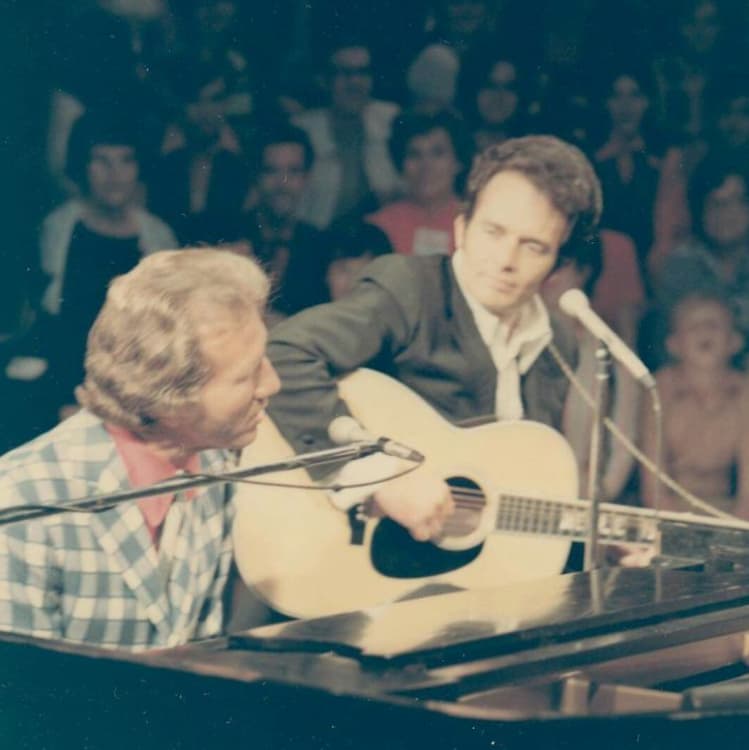
When Two Legends Sang the Same Heartbreak in Different Voices
The duet of Today I Started Loving You Again by Merle Haggard and Marty Robbins on The Ralph Emery Special in 1969 stands as one of the most quietly powerful moments in country music television. It is not defined by spectacle or production, but by something far more enduring. Presence, contrast, and truth.
By the time of this performance, the song had already begun to establish itself as a modern standard. Yet its origin adds a layer of intrigue that deepens the meaning of the duet. Haggard had originally considered giving the song to Robbins, believing it suited his smoother vocal style. That decision never materialized, and instead, the two artists would later share the stage to perform it together. What emerges in this moment is not just collaboration, but a glimpse into an alternate history of the song itself.
The performance reveals two distinct emotional interpretations coexisting within the same melody. Haggard delivers the lyrics with a grounded weight, as though the feelings are still unfolding within him. Robbins approaches the same lines with composure and distance, offering a reflective tone that suggests acceptance rather than struggle. The contrast does not divide the song. It enriches it. Each voice becomes a different answer to the same emotional question.
There is also a cultural significance to the setting. Broadcast during a period when country music had not yet fully transitioned into its modern commercial form, the performance captures an era defined by restraint and authenticity. The staging is minimal. The focus remains entirely on the artists and the song. In this simplicity, the emotional clarity becomes more pronounced.
What makes this moment especially compelling is the alignment between the song’s theme and the lives of those performing it. “Today I Started Loving You Again” speaks to the persistence of feeling, the realization that what seems resolved can return without warning. When delivered by two artists who have navigated complex personal and professional journeys, the song resonates as more than narrative. It becomes lived experience expressed in real time.
More than five decades later, the duet continues to hold attention not because of nostalgia alone, but because of its rarity. It is a convergence of voices, timing, and circumstance that cannot be recreated. In an industry that often looks forward, this performance remains a reminder of the depth that can be found by looking back.