
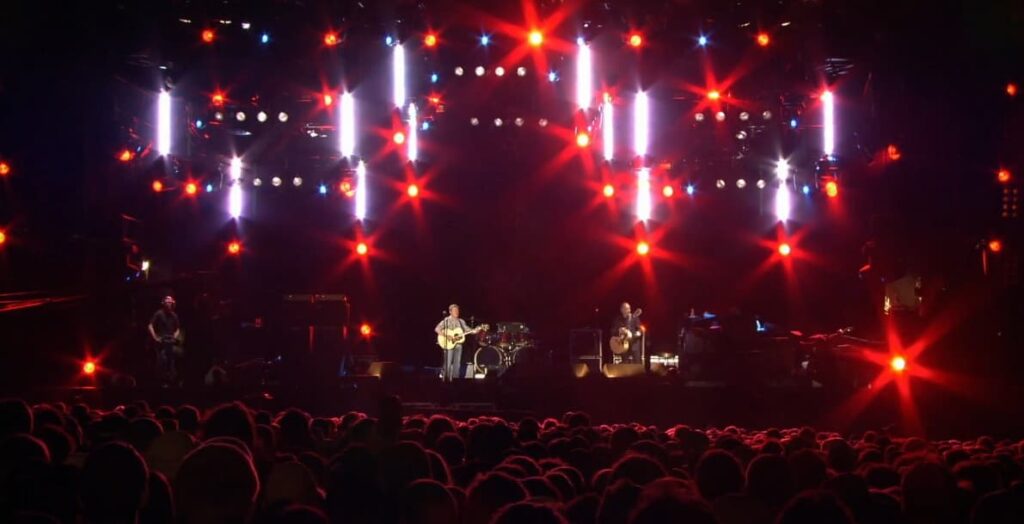
The Who Returned to the Isle of Wight and Proved Their Legacy Was Untouchable
When The Who returned to the Isle of Wight Festival in 2004, the moment carried far greater meaning than an ordinary festival appearance. More than three decades earlier, the band’s original performance at the festival in 1970 had become one of the defining events in rock history. Their return in 2004 represented both a celebration of survival and a reflection on everything the group had endured over the years.
The performance of Naked Eye became one of the standout moments of the evening. As darkness slowly settled across the festival grounds, the audience greeted the band with a level of respect and anticipation that reflected the enormous legacy surrounding The Who. Fans understood they were witnessing a group whose influence had shaped generations of rock music.
The 2004 concerts also carried emotional weight because they marked the band’s first major performances in the United Kingdom since the death of founding bassist John Entwistle in 2002. His absence was impossible to ignore. For many longtime followers of the band, Entwistle had always represented the technical and musical foundation that balanced the chaos and energy surrounding the group’s live performances.
Despite that loss, Roger Daltrey and Pete Townshend delivered a performance that reminded audiences why The Who remained one of the most respected live bands in rock history. Daltrey’s vocals still carried power and conviction, while Townshend’s guitar work preserved the intensity and emotional depth that had defined the band since the nineteen sixties.
Many fans especially praised the atmosphere at the beginning of the performance. Rather than chaotic excitement, the crowd responded with visible admiration and respect. The reaction reflected the status The Who had achieved after decades of groundbreaking music and unforgettable concerts.
Naked Eye itself has long held a special place among devoted fans because of its expansive structure and emotional depth. The song also connects to Townshend’s ambitious but unfinished Lifehouse project, an experimental concept intended to follow the success of Tommy. Although Lifehouse was never fully realized in its original form, many listeners still view songs connected to the project as some of the most creative material Townshend ever wrote.
The 2004 Isle of Wight performance ultimately demonstrated something important about The Who. Even after loss, changing eras, and decades of history, the band still possessed the ability to command a stage and create moments that felt larger than nostalgia.
For many fans in attendance, it was proof that the spirit of The Who had never truly faded.