
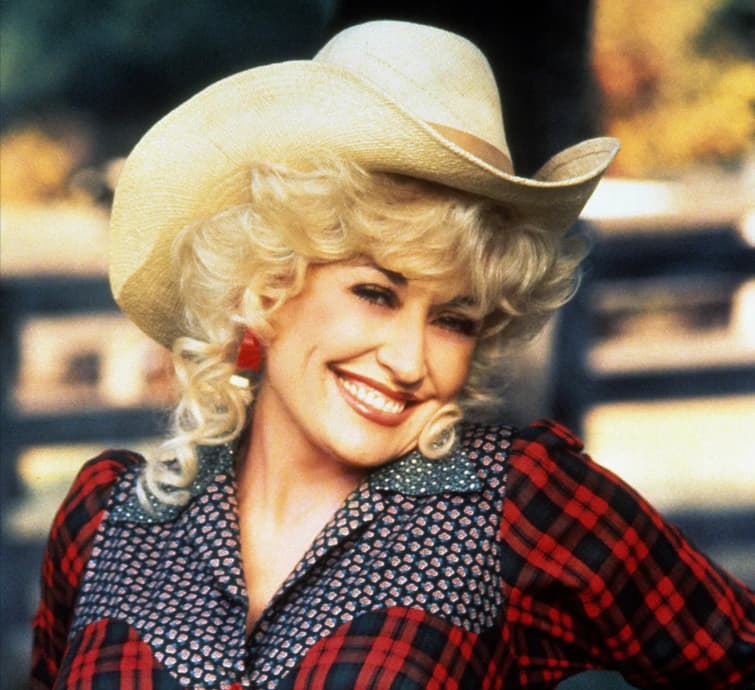
When Home Sings Louder Than Fame: Dolly Parton and the Soul of “Tennessee Homesick Blues”
In a career filled with glittering stages and global acclaim, Dolly Parton has always carried something quieter within her a deep, unshakable sense of home. Nowhere is that more evident than in her performance of “Tennessee Homesick Blues,” a song that feels less like entertainment and more like memory set to music.
Originally written for the 1984 film Rhinestone, the song quickly outgrew its cinematic origins. While the film itself faded from popular memory, the track rose to the top of the country charts, becoming one of Parton’s most enduring hits. It is a rare case where a song not only survives its context but surpasses it entirely.
On stage, Parton does not simply perform the piece; she inhabits it. There is a noticeable shift in her presence when the opening notes begin. The spectacle of fame lights, applause, expectation softens into something more intimate. Her voice, still bright and unmistakable, carries a different weight here. It is not polished perfection that draws listeners in, but a sense of truth.
The song’s emotional core lies in its simplicity. With the repeated line, “I got those Tennessee homesick blues,” Parton evokes a longing that feels both deeply personal and universally understood. It is a longing not just for a place, but for a time, a rhythm of life, and a sense of belonging that cannot be recreated.
For Parton, Tennessee is more than a setting it is her beginning. Raised in the hills of the Appalachia, she has often spoken about how those early years shaped her voice, her songwriting, and her identity. In that context, “Tennessee Homesick Blues” becomes something more than a hit song. It is a return.
What makes the performance especially compelling is its restraint. There is no need for elaborate staging or dramatic reinvention. A gentle smile, a softened gaze, the steady backing of traditional instrumentation these are enough. The quietness of the moment allows the emotion to rise, unforced and unguarded.
In an industry often defined by reinvention and spectacle, Parton’s enduring connection to her roots offers a different kind of power. Each time she sings this song, it feels as though she is not looking outward, but inward—revisiting a place that remains unchanged within her.
And perhaps that is why the song continues to resonate. Because in “Tennessee Homesick Blues,” audiences are not just hearing a performance. They are witnessing a memory one that reminds us all that no matter how far we go, some part of us is always finding its way home.