
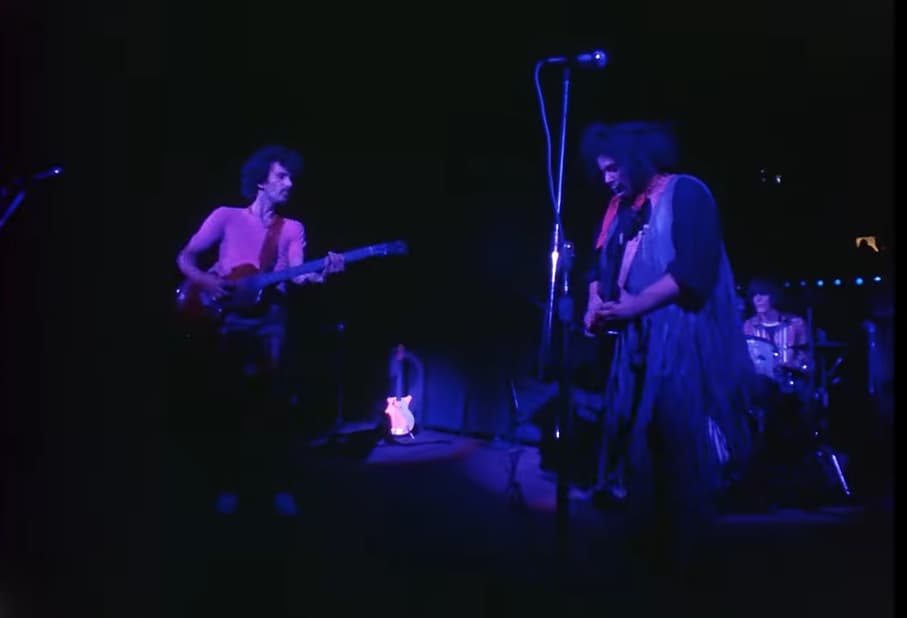
Before the Legend Took Shape: Mountain’s Quiet Moment at Woodstock 1969
In August 1969, on a stage that would soon become one of the most mythologized in music history, Mountain delivered a performance that few could have predicted would carry lasting significance. Their rendition of “Beside the Sea” at the Woodstock Festival in Bethel, New York, stands today as a revealing glimpse into a band still in its earliest form, performing before the weight of reputation or expectation had taken hold.
At the time, Mountain had not yet released a debut album. They were, by most measures, an unknown act placed alongside a lineup that included some of the most prominent names of the era. Yet within that uncertainty lay a unique kind of freedom. The performance captured a band exploring its identity in real time, guided by instinct rather than polish. Leslie West brought a raw and commanding presence, his guitar tone already hinting at the powerful style that would later define the group. Alongside him, Felix Pappalardi anchored the sound with a sense of structure shaped by his experience as both musician and producer.
“Beside the Sea” itself adds an intriguing layer to the moment. Unlike more recognizable material associated with Mountain’s later success, the song reflects a period of experimentation. Its placement within the Woodstock set reveals a band unafraid to present unfamiliar work to a massive audience. In the open air setting of the festival, the composition takes on a sense of space and fluidity, carried by the natural acoustics and the atmosphere of the gathering.
The historical context further elevates the performance. Woodstock, at that moment, was not yet the cultural landmark it would become. It was a large scale event defined by spontaneity and unpredictability. For Mountain, this meant stepping onto a stage without the burden of legacy, contributing to a collective experience that was still being formed. The absence of refinement in the recording is not a limitation but a defining characteristic, preserving the immediacy of the era.
The official release of this material decades later offers audiences a rare opportunity to revisit a foundational moment. It allows listeners to hear a band before its identity was fully established, capturing the transition from obscurity to recognition. In this sense, the performance is more than an archival curiosity. It is a document of emergence, a reminder that even the most enduring legacies often begin in uncertainty, shaped by moments that only reveal their importance with time.