
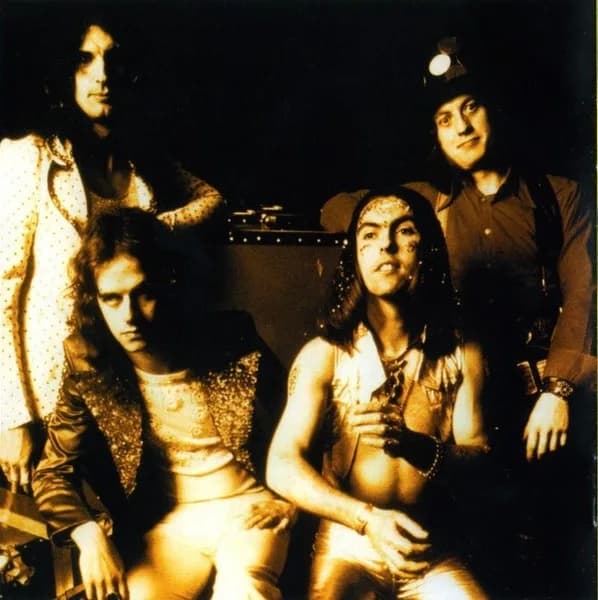
A Chorus for the Crowd and a Moment Frozen in Time .
In October 1972, inside a television studio in the Netherlands, Slade delivered a performance that would come to define their place in popular music. Appearing on TopPop with “Mama Weer All Crazee Now,” the band brought the raw energy of the live stage into a controlled broadcast environment, creating a moment that still feels immediate decades later.
At the height of the glam rock era, Slade stood apart not through theatrical mystique, but through direct connection. Their music carried the spirit of the working class communities they came from, particularly the Black Country of England. This background is audible in the structure of the song itself. It is built less as a composition to be admired and more as a chant to be shared. From the opening moments, the rhythm locks in with a sense of urgency that requires no introduction.
The vocal performance by Noddy Holder becomes the centerpiece of that connection. His voice is not polished in a traditional sense, yet it possesses a force that feels unmistakably authentic. Each line is delivered with a rough edged intensity that mirrors the communal spirit of the track. It is not about precision. It is about impact.
Equally important is the role of songwriting within the band. Holder and Jim Lea crafted a piece that captures the essence of repetition as a tool for engagement. The chorus, with its deliberately unconventional spelling, functions as both hook and identity. It invites participation, transforming listeners into contributors.
The TopPop setting adds another layer of intrigue. Television performances of the era often required a degree of restraint, yet Slade managed to project a sense of spontaneity within those limitations. The fact that multiple versions of the song were recorded on the same day highlights the professional demands placed on artists at the time, while also revealing the band’s ability to sustain intensity across repeated takes.
Viewed today, this performance represents more than a successful single. It reflects a period when British rock embraced accessibility without sacrificing character. Slade did not seek to distance themselves from their audience. They moved closer, turning a simple refrain into a collective voice.
In the end, “Mama Weer All Crazee Now” endures not because of complexity, but because of its clarity. It captures a feeling that remains instantly recognizable, a reminder that music can unite a room, a screen, and a generation in a single shared moment.