
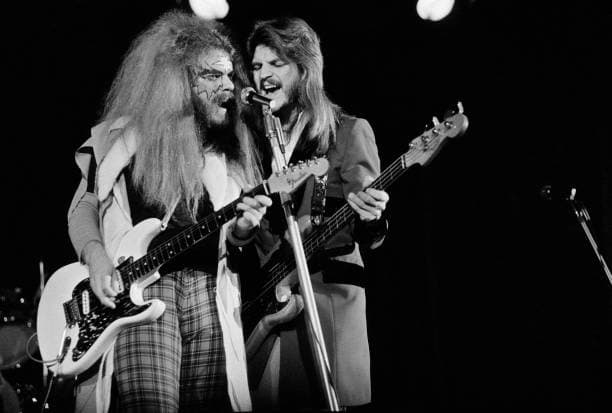
A whirling call to arms in chrome-and-horns bravado
When the Brighton-born glam-rock alchemist Wizzard unfurled their debut album Wizzard Brew in 1973 under the direction of the mercurial Roy Wood, the record staked a bold place at number 29 on the UK Albums Chart. Wikipedia+1 Amid the brass, the hard rock riffs and free-jazz interludes sits the grand, nine-minute odyssey Wear a Fast Gun, slash-and-stride, shimmering with urgency and theatricality. In this track, Wizzard channel both the swagger of rock ’n’ roll and an orchestral ambition rarely heard in the gleam-wrapped glam era.
From the moment the drums kick and Wood’s voice rises, it feels like a declaration—not simply of sound, but of intent. The music seems to don a fast gun, ready to blaze through expectation and convention. The song stands at the tail of the album’s second side, offering a culminating flourish after the earlier tracks’ wild turns. It represents Wood’s desire not just to entertain but to push boundaries.
Although there is no widely recorded account of what inspired the song’s title or narrative in literal terms, the musical and lyrical elements evoke a kind of confrontation: a readiness for battle, an embrace of risk, a willingness to out‐gun the competition or perhaps to out-run one’s own demons. The layering of horns and brass, the cello lines, the manic energy of saxophones—with hints of reflective melancholy woven into the orchestration—suggests that the “fast gun” is not just a weapon, but a metaphor for speed, force, and perhaps escape.
In the larger context of Wizzard’s journey—formed after Wood’s departure from the Electric Light Orchestra and the The Move—“Wear a Fast Gun” feels like a statement of creative liberation. Wood was eager to break free of the symmetrical pop-orchestra mould and to embrace a more chaotic, unrestrained musical palette. By embedding within this piece both swaggering rock riffs and moments of orchestral reflection, he draws a line between the visceral and the elevated. The listener hears a band that can nail a 1950s rock momentum one moment, spin into a jazz-rock free-form passage the next, and then land in a church-hymn turn of mood, as one commentator notes the introduction of “Abide with Me”-style melodic shading toward the song’s coda.
The emotional tone of “Wear a Fast Gun” oscillates between adrenaline and melancholy. It’s a celebration of moving fast, of armed readiness, but beneath the gloss there is a hint of weariness—of the cost of carrying that weapon, be it literal or symbolic. In this sense, the song delivers a rich resonance: it is one part glam bravado, one part existential confrontation. For a mature listener who has absorbed decades of music, it offers a layered experience—you hear the horns, you hear the rock, and you sense the weight behind them.
As part of the 1973 album, the song plays its role in a record that Mojo magazine later ranked among the “Top 50 Eccentric Albums”. “Wear a Fast Gun” may not have been released as a single (and thus lacks the chart minutiae of the band’s hits like “See My Baby Jive”), yet it embodies the heart of Wood’s post-ELO experiment: one foot firmly planted in rock ’n’ roll’s past, the other swinging into adventurous, orchestral territory. It reminds us why Wizzard matters—not just for glitter and pop success, but for daring to mount theatrics on a grander scale.
In short, this introduction invites the listener to strap in: you are in the back-seat of a wild musical chase, the engine roaring, the horns blaring, and the night stretching out ahead. “Wear a Fast Gun” is not merely a track—it’s a mission statement.