
When Jazz Fusion Reached Its Peak: Weather Report’s Electrifying “Black Market” Performance at Montreux 1976
In the summer of 1976, the stage of the Montreux Jazz Festival became the setting for one of the most compelling live documents of jazz fusion’s golden era. Among the many remarkable performances that year, the appearance of Weather Report stands out as a defining moment, particularly their live rendition of the powerful composition “Black Market.”
Formed in 1970 by visionary musicians Joe Zawinul and Wayne Shorter, both of whom had previously played with the legendary Miles Davis, Weather Report quickly established themselves as one of the most innovative groups in the emerging jazz fusion movement. Their music blended elements of jazz improvisation with rock rhythms, world music influences, and electronic textures, creating a sound that was both sophisticated and widely accessible.
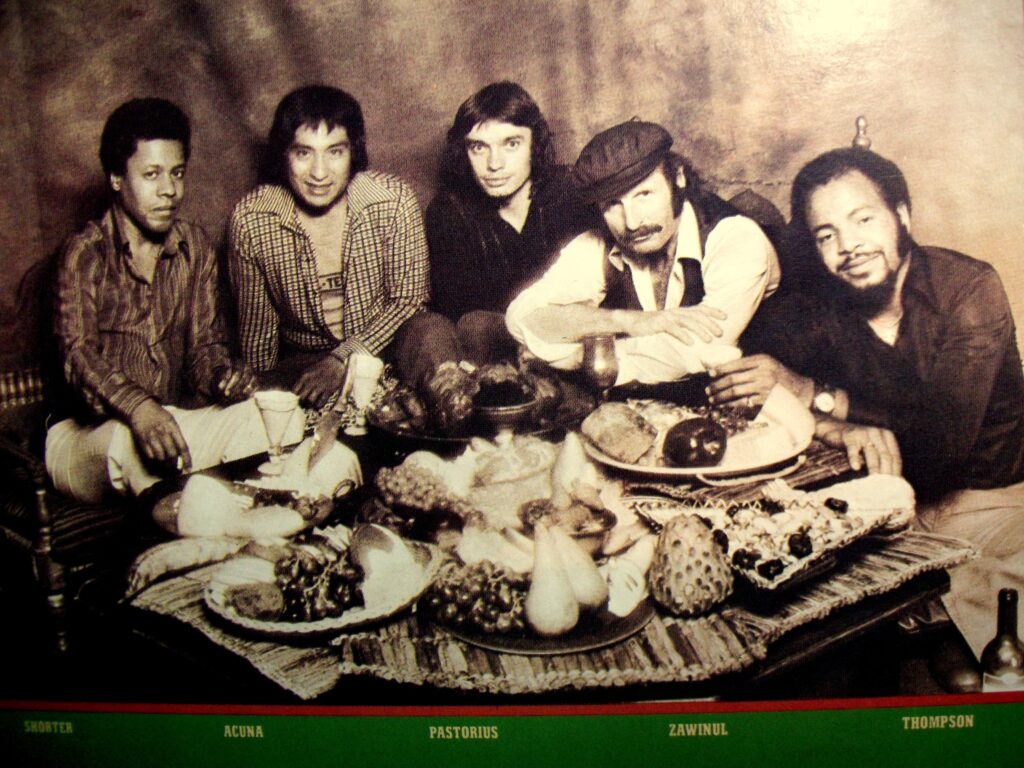
By 1976 the band had already released several influential records, but that year marked a particularly important chapter in their history. Their album Black Market had just been released, introducing a fresh musical direction and a revitalized lineup. The Montreux concert captured this transitional moment perfectly. On stage that evening were Joe Zawinul on keyboards, Wayne Shorter on saxophone, bassist Jaco Pastorius, drummer Alex Acuña, and percussionist Manolo Badrena. This configuration would soon evolve into the lineup that recorded the band’s most celebrated album, Heavy Weather in 1977.
The live performance of “Black Market” at Montreux offered a vivid showcase of the group’s musical chemistry. Joe Zawinul’s atmospheric keyboard layers established the piece’s hypnotic foundation, while Wayne Shorter’s saxophone lines moved fluidly between melodic lyricism and exploratory improvisation. The rhythm section provided remarkable energy, with Jaco Pastorius delivering a bass performance that hinted at the revolutionary impact he would soon have on modern electric bass playing.
Pastorius had joined the band only shortly before this period, yet his presence was already transforming the group’s sound. His melodic approach to the fretless bass and his dynamic stage presence added a new dimension to Weather Report’s music. In the Montreux performance, his interplay with the percussion driven groove creates a rhythmic momentum that carries the entire ensemble forward.
For many years this concert circulated only as a bootleg recording sourced from a television broadcast. Jazz collectors and fusion enthusiasts prized the footage, but its limited quality meant that much of the performance remained difficult to fully appreciate. In recent years the concert was officially restored and released in its complete form by Montreux Sounds, allowing audiences to experience the full length of the set with improved audio and visual clarity.
Today, the Montreux 1976 performance of “Black Market” remains an essential document of jazz fusion history. It captures Weather Report at a pivotal moment, standing between two landmark albums and showcasing the extraordinary musicians who would soon help define the genre’s most influential era. For listeners and historians alike, it is not simply a live performance but a snapshot of musical evolution unfolding in real time.