
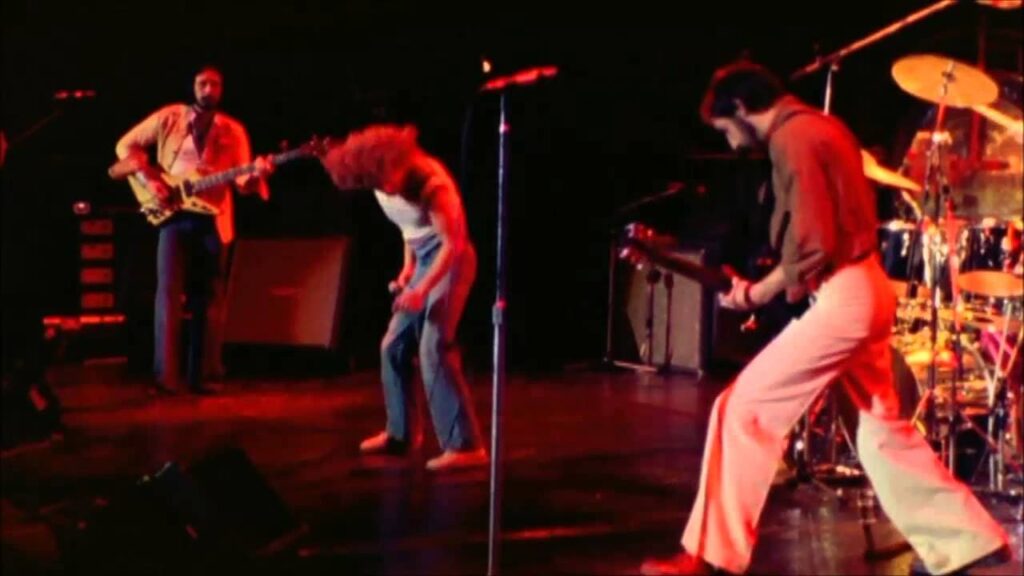
A Band on the Edge of Change: The Who’s “Substitute” at Kilburn 1977 Captures a Vanishing Era
In December 1977, a concert at London’s Kilburn Gaumont Theatre brought The Who back to the stage after a period of relative silence. What unfolded that night would later gain a significance far beyond its original intent. Filmed for what was expected to contribute to a broader documentary project, the performance remained largely unseen for decades, only to reemerge as a vital historical document of a band at a pivotal moment.
Among the standout performances was “Substitute,” a song that had long defined the group’s sharp lyrical wit and rebellious identity. In this setting, however, its meaning deepened. Originally a commentary on imitation and authenticity, the track now seemed to mirror the band’s own situation. By 1977, The Who was navigating the pressures of legacy, expectation, and internal change, giving the song an unintended layer of introspection.
The lineup on stage included Roger Daltrey, Pete Townshend, John Entwistle, and Keith Moon. For Moon, the performance would stand as one of his final major appearances. His drumming retained flashes of the explosive brilliance that had defined his career, yet it also hinted at the instability that marked his later years. This tension between power and fragility adds a poignant dimension to the footage when viewed today.
Musically, the band remained formidable. The rhythm section drove forward with urgency, while Townshend’s guitar work balanced aggression with precision. Daltrey’s vocals carried both authority and weariness, suggesting an artist aware of the weight of his own history. Together, they delivered a performance that was less about youthful chaos and more about controlled intensity.
The setlist surrounding “Substitute” further reinforces the sense of reflection. With selections spanning their most influential work, the concert functions almost as a retrospective, offering a condensed view of their evolution. This context transforms individual songs into markers of time, each one contributing to a larger narrative about endurance and change.
The delayed release of the footage has also shaped its legacy. Originally set aside due to concerns about performance quality, it now stands as an essential record precisely because of its imperfections. It captures a band in transition, unfiltered and human, rather than polished and idealized.
Today, the Kilburn performance invites both admiration and debate. It challenges viewers to reconsider what defines a great live moment. Is it technical perfection, or is it the presence of something more elusive, a sense of truth that emerges under pressure. In the case of The Who, “Substitute” at Kilburn suggests that the most enduring performances are often those that reveal not just strength, but vulnerability as well.
 Oldies Songs