
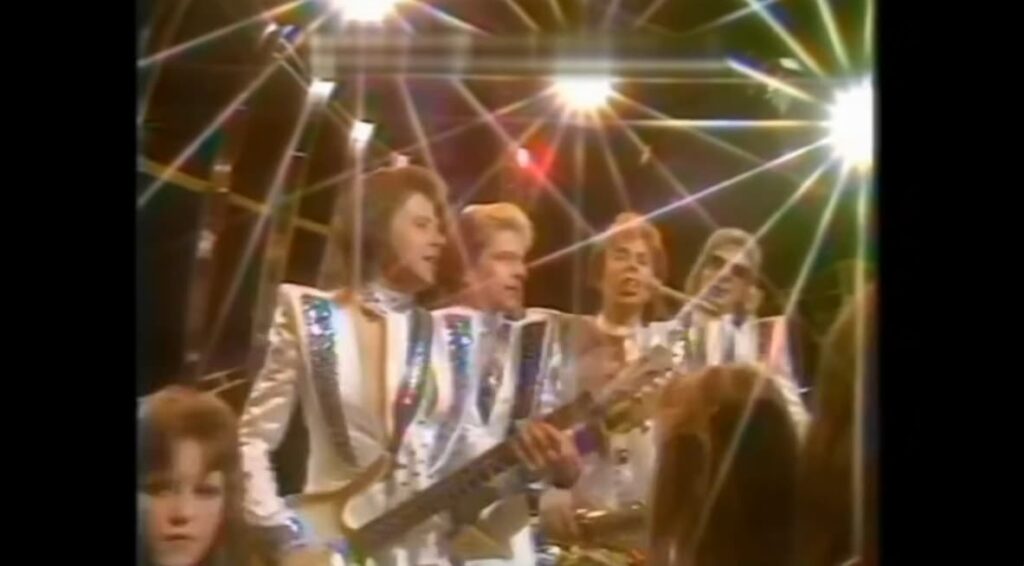
From Backing Band to Spotlight: The Glitter Band Claims Its Moment on Television
A vivid snapshot of British pop culture in the mid seventies emerges through a performance that is both celebratory and quietly significant. On November 7, 1974, The Glitter Band appeared on Top of the Pops with “Let’s Get Together Again,” delivering a moment that captures not only the spirit of glam rock but also a subtle shift in musical identity. It is a performance that rewards closer attention, revealing layers beyond its immediate charm.
At first glance, the song operates as a straightforward invitation. Its melody is accessible, its rhythm designed for participation, and its chorus built to unify an audience. Yet beneath that simplicity lies a deeper narrative. The Glitter Band had recently stepped out from the shadow of Gary Glitter, transitioning from a supporting role into a self defined act. This performance therefore carries an unspoken message of independence, framed within a song about togetherness.
The setting amplifies that message. Top of the Pops was more than a platform. It was a cultural gatekeeper that shaped public perception of pop music in the United Kingdom. Appearing on its stage meant reaching millions, but it also meant adapting to a format where visual presentation mattered as much as sound. In this environment, the band’s coordinated image and confident stage presence become integral to the experience, reinforcing the collective identity that distinguishes them.
Unlike many acts of the era, there is no singular front figure dominating the frame. Instead, the performance emphasizes unity. Each member contributes to a cohesive whole, reflecting a different model of stardom where the group itself becomes the focal point. This approach aligns naturally with the song’s theme, creating a rare harmony between message and presentation.
The historical context adds further depth. Glam rock in 1974 was at its height, characterized by bold aesthetics and direct engagement with audiences. This performance embodies those qualities while also hinting at the genre’s broader appeal. It demonstrates how music, image, and media could converge to create moments that were both entertaining and culturally resonant.
Viewed today, the clip invites reflection and debate. It raises questions about authenticity in televised performances, particularly in an era when live vocals were not always the priority. It also prompts consideration of legacy. Can a group that began as a backing act redefine itself in the public imagination, or does its origin continue to shape how it is remembered.
In this case, The Glitter Band offers a compelling answer. Through clarity of purpose and a strong sense of identity, they transform a simple pop performance into a statement of arrival, one that continues to resonate with audiences who value both nostalgia and reinvention.