
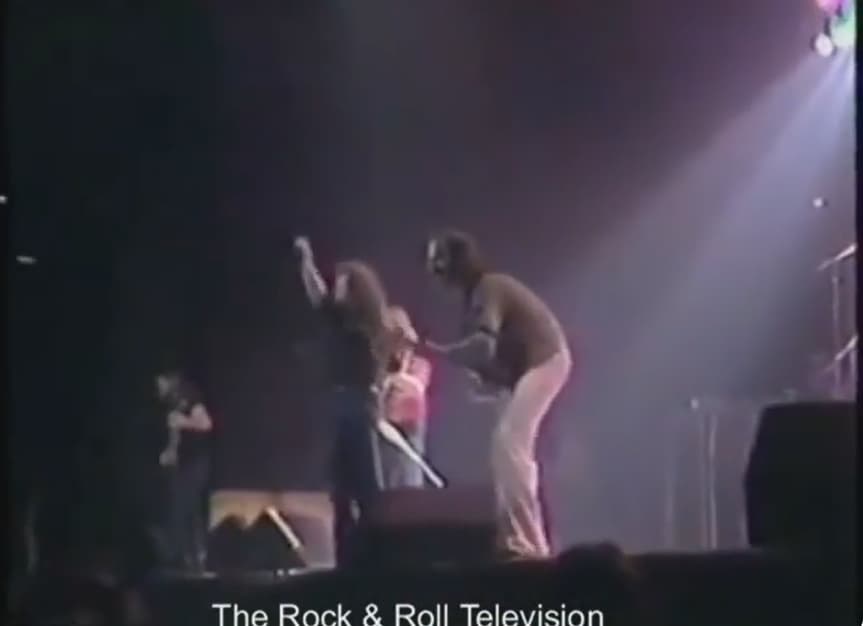
At the Crossroads of Identity Molly Hatchet Faces a Defining Night in 1980
On June 24, 1980, Molly Hatchet took the stage at the Capital Centre in Maryland to perform “Crossroads,” a moment that now reads as both a performance and a turning point. What should have been another chapter in the band’s rising success instead revealed the fragile balance between continuity and change.
At the center of attention stood Jimmy Farrar, stepping into the role once held by Danny Joe Brown. Brown’s absence, due to health concerns, marked a significant shift for a group whose identity had been closely tied to his unmistakable Southern vocal grit. Farrar brought strength and control, yet his tone carried a different character, one that leaned toward a more conventional rock style. For many in attendance, the contrast was impossible to ignore.
The setting itself contributed to the atmosphere. A venue designed for thousands appeared only sparsely filled, creating a visual and emotional gap between expectation and reality. Such conditions can shape a performance in subtle ways. Energy that would normally feed off a large crowd instead had to be generated internally, placing additional pressure on the musicians to sustain momentum.
“Crossroads” proved to be a particularly telling choice. The song’s long association with themes of decision and consequence took on new meaning in this context. It was no longer simply a reinterpretation of a blues standard linked to Robert Johnson, but a reflection of the band’s own position at a moment of uncertainty. The performance carried an undercurrent of determination, as though the group was asserting its continuity even as its foundation shifted.
Instrumentally, the band remained formidable. The dual and triple guitar interplay from Dave Hlubek, Steve Holland, and Duane Roland preserved the driving force that had defined their earlier work. The rhythm section, anchored by Banner Thomas and Bruce Crump, maintained a steady backbone, ensuring that the music itself never faltered even as the broader context invited scrutiny.
For longtime followers, the night evokes a complex mix of loyalty and doubt. Some view it as the beginning of a gradual decline, pointing to the lineup change and reduced audience turnout as early warning signs. Others see it as an example of resilience, a band continuing to perform with conviction despite challenging circumstances.
What remains undeniable is the symbolic weight of the moment. “Crossroads” became more than a song in the setlist. It stood as a mirror to the band’s reality, capturing a point where past success and future uncertainty converged. In hindsight, this performance endures not for its perfection, but for its honesty, offering a rare glimpse into the pressures that shape even the most established acts.