
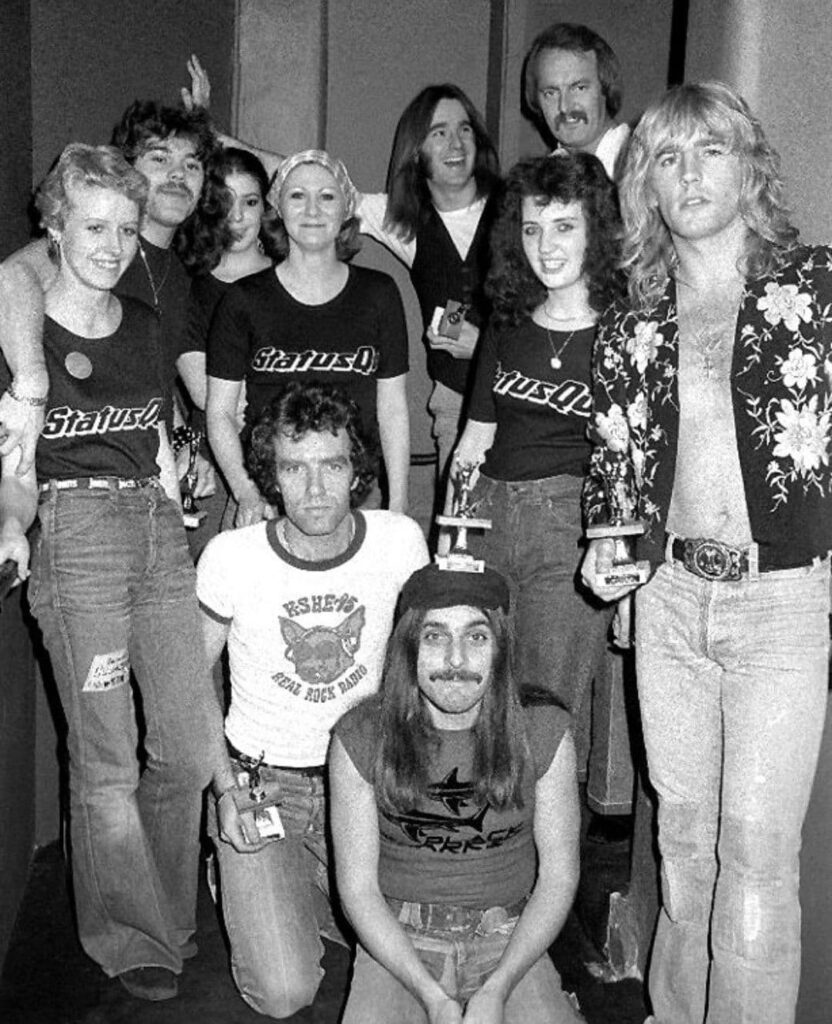
When the First Note Ignites Everything Status Quo Deliver a Guitar Moment That Endures .
In the landscape of late seventies rock television, few performances capture the paradox of control and spontaneity quite like “For You” by Status Quo. Presented in a mimed format, as was common for broadcast standards of the time, the clip might suggest distance from authenticity. Yet what unfolds tells a very different story, one where technique, chemistry, and sheer musical instinct overcome any limitation imposed by the medium.
From the very first note, the performance establishes its authority. The familiar boogie driven rhythm creates a steady foundation, but it is the interplay between Rick Parfitt and Francis Rossi that commands attention. Their partnership, refined through years of touring and recording, operates with an almost intuitive precision. Even in a controlled studio environment, the connection between them feels immediate and unforced.
The defining moment arrives midway through the track. Around the one minute forty five mark, Rossi’s guitar solo emerges not as a display of technical excess, but as a focused release of energy. Each phrase builds with clarity and intent, drawing the listener deeper into the structure of the song. It is a reminder that great solos do not rely on complexity alone, but on timing, tone, and emotional direction. For many fans, this passage has become one of the most memorable in the band’s catalogue, a moment revisited repeatedly for its impact.
Visually, the performance offers a snapshot of an era. The styling, the stance, and the unembellished staging reflect a time when rock presentation leaned on presence rather than production. There is a sense of directness that modern broadcasts often replace with polish. This simplicity enhances the focus on musicianship, allowing the audience to engage with the core elements of the band’s sound.
The use of miming continues to invite debate. Some viewers question whether the absence of live execution diminishes the experience. Others argue that the emotional effect remains intact, pointing to the band’s ability to convey intensity regardless of format. In this case, the latter perspective finds strong support. The performance feels alive, not because it is technically live, but because it communicates conviction.
Beyond the surface, “For You” reveals another dimension of Status Quo. While often associated with straightforward, high energy tracks, the band demonstrates a more nuanced command of dynamics and phrasing here. The song becomes less about repetition and more about subtle variation within a familiar framework.
Decades later, this performance continues to resonate. It stands as proof that even within constraints, great musicians find ways to express something genuine. What begins as a controlled television segment ultimately becomes a lasting statement of style, discipline, and enduring musical identity.