
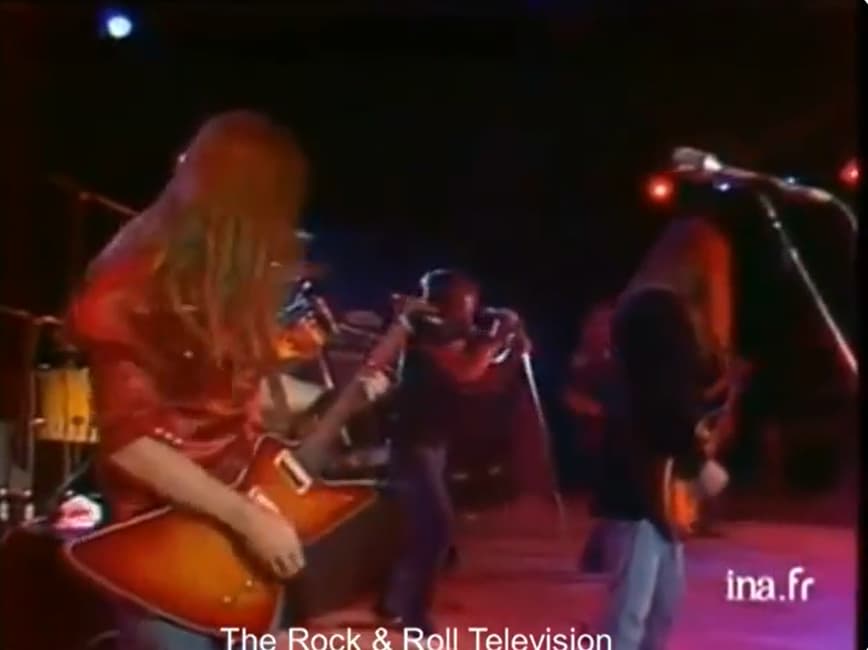
Paris 1979 Captures Molly Hatchet at Full Throttle
A rare performance of Molly Hatchet in Paris in 1979 offers a compelling snapshot of a band operating at its creative and technical peak. The footage of “Big Apple” presents a lineup widely regarded by fans as definitive, featuring Danny Joe Brown on vocals, Dave Hlubek, Duane Roland, and Steve Holland on guitars, Banner Thomas on bass, and Bruce Crump on drums. Together, they deliver a performance that underscores why the group became a defining force in southern rock during the late 1970s.
The Paris setting adds a layer of intrigue. At a time when American southern rock was still carving out its identity internationally, Molly Hatchet brought a distinctly American sound to a European audience. The band’s trademark triple guitar attack is immediately evident, creating a dense, driving wall of sound that remains tightly controlled. Rather than descending into excess, the arrangement highlights discipline and cohesion, qualities that are sometimes overlooked in discussions of the genre.
Central to the performance is Danny Joe Brown’s commanding vocal presence. His delivery is raw yet controlled, carrying both grit and melodic clarity. Some fans have drawn comparisons between Brown and Steve Perry, noting a similar ability to balance power with accessibility. While the comparison is stylistically unconventional, it reflects the high regard for Brown’s role in shaping the band’s identity during this period.
Instrumentally, the performance offers several standout moments. Duane Roland’s guitar work, in particular, draws attention for its precision and intensity. His solo sections are executed with a sharp sense of timing, avoiding unnecessary embellishment while still delivering impact. The interplay between the three guitarists demonstrates a structured approach rather than competition, reinforcing the band’s collective sound.
Audience reactions and later commentary suggest that this era represents a high point for Molly Hatchet. The combination of strong songwriting, cohesive musicianship, and a clear artistic direction positioned the band among the leading acts in southern rock at the time. The Paris footage serves as visual and sonic evidence of that status.
The performance also invites broader discussion about the evolution of the genre. Many viewers regard this period as a benchmark, contrasting it with later shifts in style and lineup changes. Whether seen as a peak or simply a moment of alignment, the 1979 Paris recording remains a valuable document. It captures a band fully engaged with its identity, delivering a performance that continues to resonate with audiences decades later.