
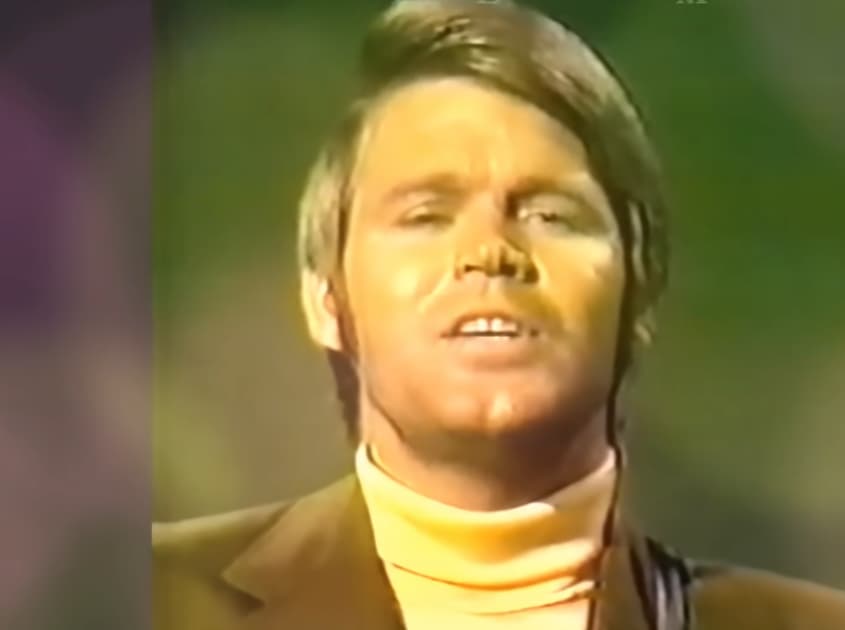
A performance that refused to shout, yet the world listened
In 1968, at a time when popular music was growing louder and more rebellious, Glen Campbell delivered something radically different. His live performance of Wichita Lineman did not rely on spectacle or vocal power. Instead, it introduced a rare presence on stage, a quiet intensity that drew audiences inward rather than pushing outward.
Written by Jimmy Webb, the song itself was an unusual creation. Inspired by the image of a solitary telephone line worker standing against an endless landscape, Webb crafted a story that felt both deeply personal and universally distant. What made the composition even more intriguing was its incomplete structure. One verse was never fully written, leaving space for an instrumental passage that feels less like a musical bridge and more like a lingering thought that refuses to resolve.
This sense of incompleteness became one of the defining strengths of the performance. Campbell did not attempt to fill the gaps with embellishment. He leaned into them. His delivery remained restrained, almost observational, as if he were channeling the inner voice of the character rather than performing for an audience. The result was a rare alignment between song and stage, where the emotional core of the music was mirrored perfectly in its presentation.
The opening moments of the performance set the tone immediately. There was no dramatic introduction, no buildup. It felt as though the audience had stepped into the middle of an ongoing moment. As the song progressed, the absence of visible effort became its own kind of statement. Campbell did not need to prove anything. His stillness carried the weight.
Equally striking was the ending. There was no grand conclusion, no emotional peak designed to elicit applause. The song simply faded, leaving behind the impression that the story continued somewhere beyond the stage. It is this unresolved quality that has allowed the performance to endure. Viewers are not given closure. They are left with a feeling.
More than five decades later, this rendition of Wichita Lineman remains a compelling study in contrast. It stands as proof that a performance does not need to be loud to be powerful. Sometimes, the most unforgettable moments in music come from what is not said, what is not finished, and what quietly stays with the listener long after the sound disappears.
 Oldies Songs