
Rewriting the Script on Stage: The Glitter Band’s “Don’t Make Promises” Challenges Expectations in 1976
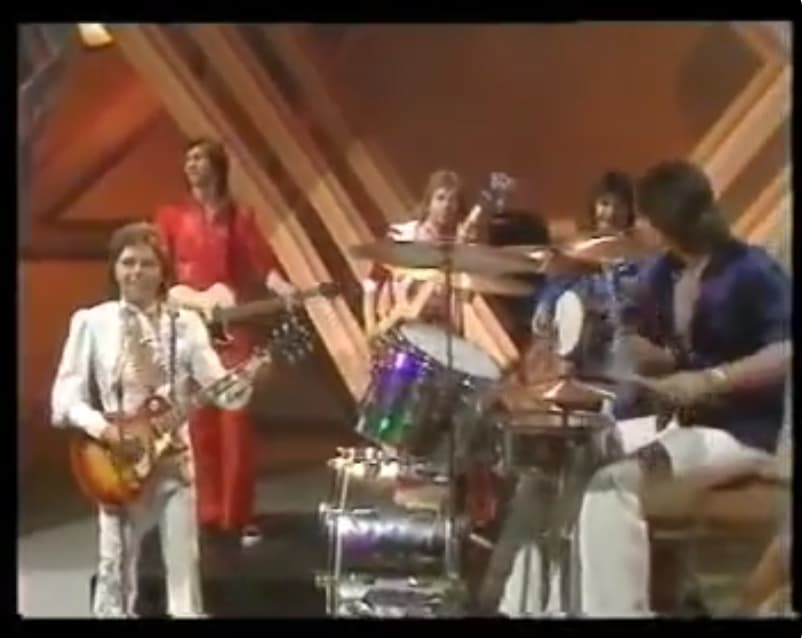
A 1976 performance of “Don’t Make Promises” by The Glitter Band offers a rare and revealing departure from the group’s established onstage format. Known for its dual drummer setup and tightly structured glam rock presentation, the band appears here in an altered configuration that immediately draws attention. This version presents not only a shift in instrumentation but also a broader look at the group’s adaptability during a period of evolving musical identity.
One of the most notable aspects of the performance is the reallocation of roles among members. Tony Leonard, typically associated with drumming duties, is seen handling guitar responsibilities in this arrangement. Such a change is uncommon for the band and suggests a willingness to experiment within the constraints of live or televised production. Similarly, other members appear to move between instruments, creating a fluid stage dynamic that contrasts with the more rigid setups often associated with glam rock acts of the time.
At the center of the performance is Gerry Shephard, whose presence remains a defining element. His vocal delivery maintains the melodic clarity and tonal warmth that characterized many of the band’s recordings. In this setting, his role extends beyond singing, as he contributes instrumentally as well, reinforcing the collaborative nature of the arrangement. His contribution continues to be a focal point in retrospective discussions, particularly in light of his lasting influence on the band’s identity.
The song itself reflects the accessible, upbeat qualities that defined much of the group’s catalog. Its structure is straightforward, built around a strong melodic hook and a rhythm section that prioritizes consistency over complexity. These attributes have led some listeners to question why the track did not achieve broader commercial success, particularly in markets such as the United States. Industry observers have pointed to promotion strategies and shifting musical trends as possible factors, though no single explanation fully accounts for its reception.
The performance also highlights the transitional nature of the mid 1970s music landscape. Glam rock was beginning to share space with emerging genres, and bands often adapted their presentation in response. In this context, the willingness of The Glitter Band to modify its lineup and instrumentation can be seen as both a practical decision and an artistic one.
Audience responses over time reflect a mixture of nostalgia and critical reassessment. Many view the performance as evidence of the band’s versatility, while others focus on the missed commercial opportunities associated with songs like “Don’t Make Promises.” This dual perspective contributes to the clip’s ongoing relevance.
Ultimately, the 1976 recording stands as a document of experimentation within a genre often defined by visual consistency. It captures a moment when The Glitter Band expanded its approach, offering a performance that continues to invite analysis and renewed appreciation.