
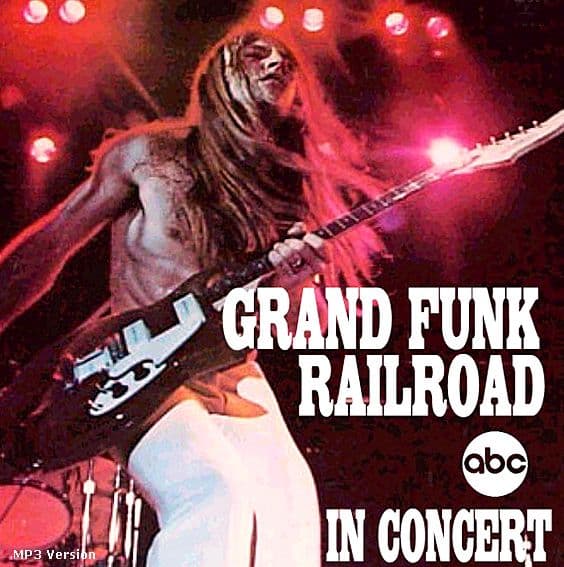
A Stolen Concert, A Raw Band, and a Film That Refused to Stay Still: Grand Funk Railroad’s “Into The Sun” Live 1970
On January 16 and 17, 1970, Grand Funk Railroad took the stage at the Pirates World Amusement Park, an unlikely setting for a band that thrived on volume, grit, and sheer physical force. This was not a stadium, nor a traditional concert hall. It was a theater inside an amusement park, a place built for spectacle of a different kind. Yet what unfolded there would become one of the strangest and most compelling fragments of early American hard rock history.
Behind the camera stood Barry Mahon, operating almost entirely alone. Armed with a single camera, Mahon captured what he could, resulting in footage that feels constrained yet strangely intimate. The limitations are obvious: narrow angles, incomplete coverage, moments that seem to begin or end abruptly. But rather than conceal these gaps, Mahon filled them with psychedelic drawings and abstract visuals, creating a hybrid experience that sits somewhere between concert film and underground cinema.
The real controversy, however, came after the performance. Without the consent of the band, Mahon inserted the footage into his earlier film Mondo Daytona, repackaging it in 1970 under the new title Weekend Rebellion. In the process, even the music was misrepresented. “Into The Sun” was mislabeled as “On Time,” and other songs were similarly altered, blurring the line between documentation and distortion. The concert was no longer just a performance. It became part of a cinematic artifact that the band neither controlled nor authorized.
And yet, within that chaos lies its enduring value.
This footage captures Grand Funk Railroad before polish, before mass commercialization, before they became one of the defining arena acts of the decade. The performance of “Into The Sun” is especially revealing. Not a major hit at the time, the song functions here as a statement of intent. The band plays with urgency and rawness, pushing forward rather than refining. Guitar lines feel unrestrained, rhythms surge rather than settle, and the overall sound carries a sense of a group still in the act of becoming.
Even the structure of the film reflects this instability. Drawn from two consecutive nights, the footage forms a kind of collage rather than a single, unified event. Time is blurred. Continuity is secondary. What matters is the energy preserved within each fragment.
Decades later, the material would resurface again under yet another title, Get Down Grand Funk, continuing its pattern of reinvention. But no matter the name, the core remains unchanged.
This is not a perfect document. It is something far more interesting: a raw, unauthorized glimpse into a moment when rock music was still volatile, still uncontained, and still very much up for grabs.