
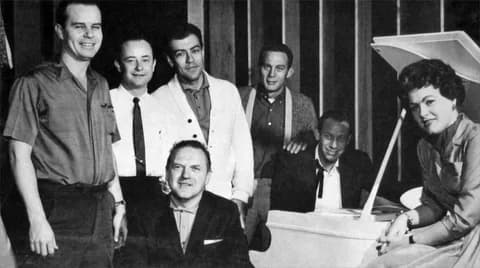
A Voice Untouched: Patsy Cline and the Quiet Perfection of “You Belong To Me”
In an era long before digital correction reshaped the sound of popular music, a recording like “You Belong To Me” stands as a reminder of what pure vocal artistry once demanded. Delivered by Patsy Cline and supported by The Jordanaires, the track reveals a level of control and emotional clarity that continues to resonate with listeners across generations.
What immediately distinguishes this performance is its sense of ease. Cline does not approach the song with overt dramatics or technical display. Instead, she allows the melody to unfold naturally, shaping each phrase with subtle precision. Her intonation is remarkably accurate, yet it never feels clinical. There is warmth in every note, a quiet confidence that reflects years of instinctive musical understanding rather than reliance on studio intervention.
The recording also exemplifies the influence of the Nashville Sound, a production style that sought to bridge country and pop audiences during the late 1950s and early 1960s. Smooth arrangements, restrained instrumentation, and carefully layered harmonies define this approach. Within that framework, The Jordanaires provide a gentle vocal backdrop, enhancing rather than competing with Cline’s lead. Their presence adds depth and softness, allowing the performance to maintain its intimate character while achieving a polished finish.
“You Belong To Me” itself carries a timeless emotional core. The song speaks of longing and connection, yet in Cline’s interpretation, it avoids excessive sentimentality. She communicates feeling through restraint, choosing nuance over intensity. This balance is what makes the performance so enduring. It invites the listener inward rather than overwhelming them, creating a sense of closeness that few recordings manage to sustain.
From a technical perspective, the performance offers much to admire. Her legato phrasing flows seamlessly, and her use of vibrato is measured and expressive rather than decorative. These qualities contribute to a vocal style that feels conversational, as though the song is being shared rather than performed. It is this natural quality that continues to challenge even trained singers who attempt to replicate her approach.
There is also an added poignancy when listening today. Patsy Cline’s life was cut short in 1963, leaving behind a catalog that feels both complete and unfinished. Each recording carries the weight of what might have been, and “You Belong To Me” is no exception. It stands not only as an example of technical excellence, but as a lasting imprint of a voice that defined an era.
In a modern landscape shaped by technology, this performance invites a different kind of appreciation. It asks a simple question that continues to spark discussion among listeners and musicians alike. What does it mean to sound truly natural, and can that quality ever be recreated once it is gone.
 Oldies Songs