
Before the Legends Had Names: A Rare 1957 Television Moment That Captured Country Music in Its Purest Form
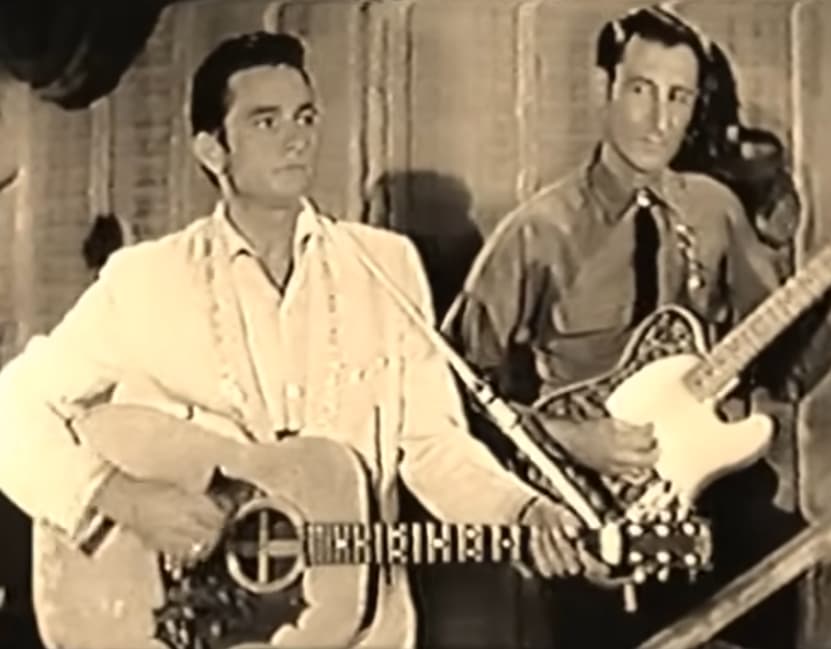
In an era before stadium tours and polished television specials, a quiet black and white broadcast of Tex Ritter’s Ranch Party offered something far more enduring than spectacle. A recently resurfaced 1957 clip featuring Johnny Cash, Patsy Cline, and Bobby Helms is drawing renewed attention not for what it presents, but for what it quietly reveals.
At first glance, the performance feels almost disarmingly simple. There is no elaborate staging, no dramatic lighting, and no visible attempt to impress. The artists stand close together, sharing space and sound in a way that feels more like a gathering than a production. Yet within that simplicity lies a rare historical convergence. These were not yet untouchable icons, but emerging voices still shaping their identities.
For Johnny Cash, this moment arrives at a critical early stage. Having only recently broken through with “I Walk the Line,” he appears here not as a towering figure of American music, but as an artist still earning his place. His restrained delivery and steady presence suggest a performer grounded in discipline, even as fame begins to approach. The performance gains added meaning when viewed in retrospect, as the themes of emotional control and personal conviction in his music mirror the position he occupied at the time.
Patsy Cline’s presence offers a parallel narrative. Fresh from the success of “Walkin’ After Midnight,” she brings a vocal clarity and emotional depth that would later define her legacy. Yet in this setting, there is a sense of discovery rather than dominance. Her voice carries both confidence and vulnerability, capturing an artist in transition rather than at her peak. It is a reminder that even the most timeless voices were once in the process of becoming.
Bobby Helms completes the picture with a grounded, accessible style that reflects the everyday roots of country music. His role in the performance reinforces the communal spirit of the genre during this period, where collaboration and authenticity took precedence over individual spotlight.
What makes this recording particularly compelling is the absence of awareness. None of the performers appear to recognize the historical weight of the moment. There is no sense of legacy being formed, no indication that this modest television appearance would later be viewed as a document of origins. That unintentional quality gives the clip its lasting power.
In today’s music landscape, where production often defines perception, this fragment from 1957 stands as a quiet counterpoint. It reminds audiences that country music once relied on little more than voice, presence, and truth. More importantly, it offers a rare opportunity to witness greatness not at its height, but at its beginning.
Video: