
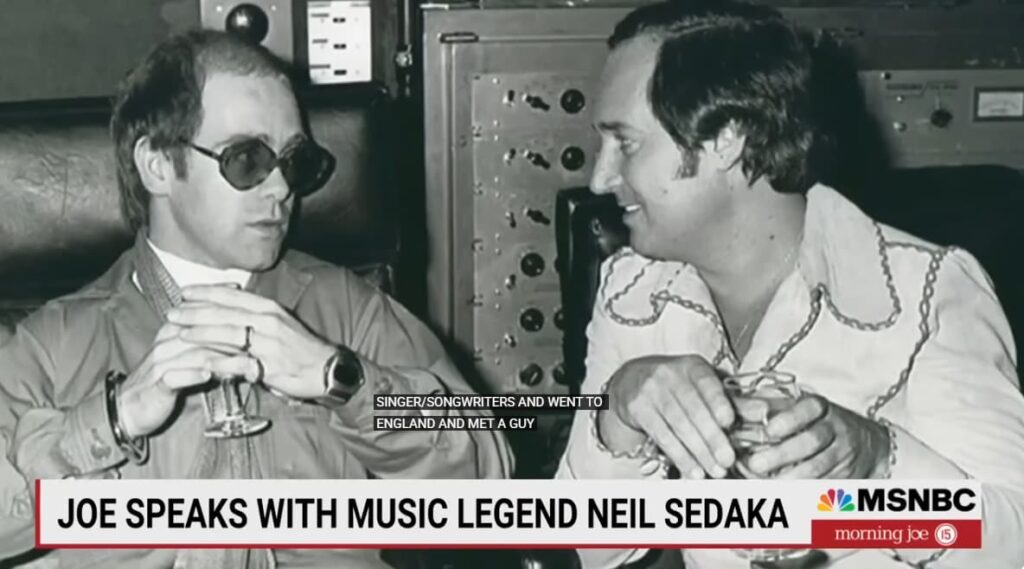
The Sound of Immortality: Neil Sedaka Looks Back on Decades of Songwriting
In a recent televised conversation in Los Angeles, veteran singer songwriter Neil Sedaka offered a clear and reflective look at a career that has spanned more than six decades. At eighty three, Sedaka continues to perform and engage with audiences, while revisiting the songs that established him as one of the most consistent hitmakers of the late 1950s and early 1960s.
Speaking with Joe Scarborough, Sedaka discussed both the origins of his early success and the challenges that followed. He recalled writing hits such as “Breaking Up Is Hard to Do” and his early breakthrough as a songwriter for Connie Francis with “Stupid Cupid.” These achievements were part of a period when Sedaka recorded a series of Top Ten singles, establishing a strong commercial presence in the American pop market.
Sedaka also reflected on the disciplined songwriting environment of the era. Working in small offices with minimal resources, young writers were expected to produce material consistently, often on modest salaries. According to Sedaka, the process required persistence and creative endurance, with no guarantee of immediate success. He emphasized that songwriting remained a demanding craft, shaped by repetition and continuous effort rather than inspiration alone.
The conversation turned to “The Immigrant,” a song Sedaka wrote in part as a gesture of support for John Lennon during a period when Lennon faced immigration challenges in the United States. Sedaka noted that the song also reflected his own background, coming from a family of immigrants, as well as that of his co writer. He acknowledged that its themes have remained relevant over time, particularly in discussions about the role of immigrants in American society.
Like many artists of his generation, Sedaka faced a significant career downturn during the rise of The Beatles and The Rolling Stones, when musical trends shifted rapidly. He described this period as a moment when he was largely seen as part of an earlier era. However, his career revival in the mid 1970s marked a turning point. A key factor in that comeback was his connection with Elton John, who signed him to Rocket Records and helped reintroduce his music to a new audience. The release of “Laughter in the Rain” became a major success during this phase.
In more recent years, Sedaka adapted to changing circumstances by performing short online concerts during the global pandemic, maintaining a connection with longtime listeners. These performances, often simple in format, resonated with audiences seeking familiarity and comfort.
Reflecting on his legacy, Sedaka offered a perspective grounded in longevity rather than momentary success. He stated that the songs themselves would endure beyond his lifetime, describing them as a form of immortality. For Sedaka, this lasting presence of his work remains the most meaningful achievement of his career.
 Oldies Songs