
When Music Becomes a Lifeline
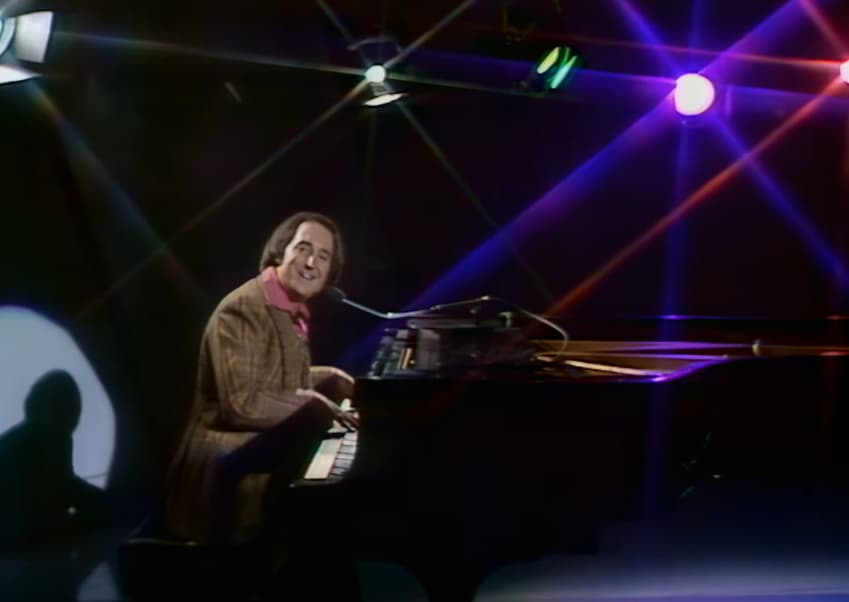
A resurfaced clip of “That’s When The Music Takes Me” performed by Neil Sedaka on The Russell Harty Show in 1973 is drawing renewed attention from audiences reassessing the artist’s legacy. Though modest in scale compared to large stage productions, the televised performance offers a revealing snapshot of Sedaka at a pivotal moment in his career.
At the time of this appearance, Sedaka was navigating a transitional period. After achieving major success in the early 1960s, his popularity in the United States had declined toward the end of that decade. By the early 1970s, he had shifted focus to the United Kingdom, where new collaborations and television exposure helped reintroduce his work to a different audience. Programs such as The Russell Harty Show played an important role in that reemergence.
The performance itself is notably restrained. Seated at the piano, Sedaka delivers the song with clarity and control, placing emphasis on melody and lyrical expression rather than visual spectacle. This approach has prompted many viewers to reconsider assumptions that his success relied heavily on studio production. While recordings like “Breaking Up Is Hard to Do” are often associated with polished arrangements, this live setting highlights the underlying craftsmanship of his songwriting.
“That’s When The Music Takes Me” carries a personal tone that resonates strongly in this context. The song reflects on the role of music as a source of direction and emotional grounding. In light of Sedaka’s career trajectory at the time, the lyrics can be understood as more than narrative. They suggest a connection between the artist’s professional challenges and his continued reliance on music as a stabilizing force.
Audience responses to the clip frequently emphasize this sense of authenticity. Viewers have described the performance as a reminder that Sedaka’s abilities extend beyond the label of pop entertainer, pointing instead to a consistent level of musical discipline. Comments also highlight how the simplicity of the arrangement allows the emotional core of the song to come forward without distraction.
In retrospect, the 1973 appearance stands as a meaningful document of transition. It captures an artist in the process of rebuilding his presence while reaffirming his identity through performance. For contemporary audiences, the clip offers a clearer understanding of Neil Sedaka not only as a figure of popular music history, but as a songwriter and performer whose work retains substance beyond its era.