
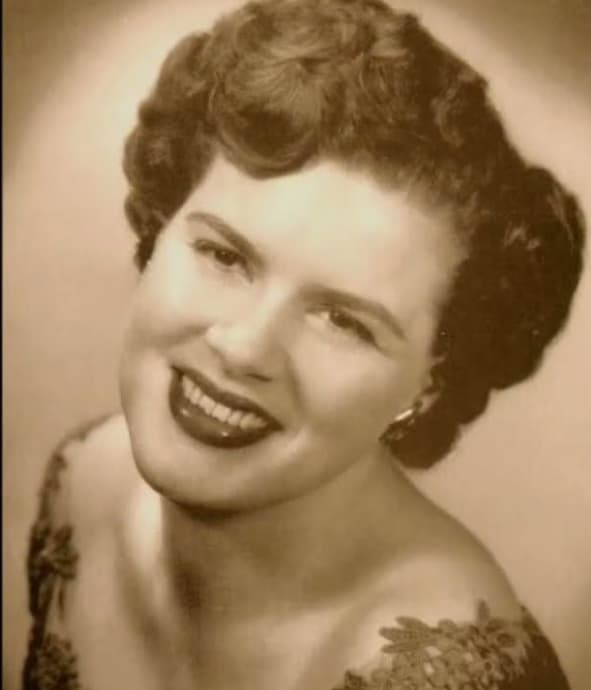
A Voice That Stayed Behind: The Rare 1962 Television Performance That Reveals Patsy Cline at Her Most Human
In an era when television moved quickly and memories faded even faster, a quiet broadcast from Nashville has returned with unexpected weight. A rare performance of “Why Can’t He Be You” by Patsy Cline, originally aired on WSM-TV on September 25, 1962, is now circulating again, offering audiences a glimpse into a moment that was never meant to last this long.
The recording stands apart from most circulating clips of the song. While many versions online rely on studio audio layered over unrelated footage, this performance traces back to an actual live television appearance. The vocal heard today has been carefully restored and synchronized from the 2012 release On The Air: Her Greatest TV Performances, preserving both the immediacy of the original broadcast and the clarity of modern remastering.
At first glance, the performance feels understated. There is no elaborate staging, no dramatic buildup. Yet that simplicity reveals something far more compelling. Cline delivers the song with a restraint that draws attention to every pause, every held note, every glance that seems to drift somewhere beyond the camera. It is less a performance than a quiet confession unfolding in real time.
Written by Hank Cochran, a close collaborator of Cline, the song itself explores a deeply familiar tension. It tells the story of loving someone who is present while still being emotionally tied to someone who is not. In this television setting, that narrative takes on a different weight. Without the polish of studio production, the lyrics feel less like composition and more like lived experience. The emotional distance described in the song becomes visible in the stillness of her delivery.
Context adds another layer to the performance’s resonance. By late 1962, Cline had already reached a defining point in her career, balancing widespread recognition with the personal and professional pressures that often accompany success. Seen through that lens, the performance carries a sense of quiet vulnerability, as though the artist is navigating something unspoken beneath the surface.
What makes this footage particularly significant is its rarity. Television appearances from this period were often ephemeral, broadcast once and rarely preserved with care. That this moment survives at all, now restored and shared with a new generation, gives it an archival importance that extends beyond the song itself.
In the end, the power of this performance lies not in spectacle but in its honesty. It captures an artist at a specific point in time, delivering a song that was never intended to be her most famous, yet has endured precisely because it feels so real. For modern viewers, it is more than a rediscovered clip. It is a reminder that sometimes the most lasting moments are the ones that were never designed to last at all.