
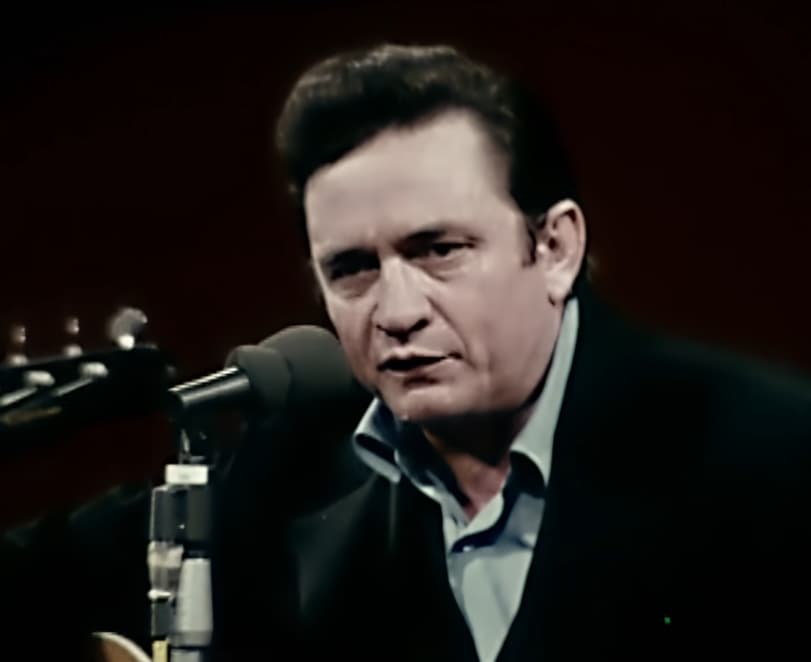
The Day Laughter Echoed Through Prison Walls and Made Johnny Cash Unstoppable
On February 24, 1969, inside San Quentin State Prison, a performance unfolded that would defy expectations and reshape the trajectory of American music. When Johnny Cash stepped onto the stage, he was not introducing a carefully rehearsed hit. Instead, he carried a new song he had barely practiced, one that would soon become one of the most recognizable live recordings of his career.
That song was A Boy Named Sue, a narrative driven piece that begins with humor but evolves into something far more complex. Delivered in Cash’s signature conversational style, the performance immediately sparked a reaction. Laughter erupted from the audience of inmates, not as polite applause, but as a raw and instinctive response. The room felt alive, unpredictable, and deeply engaged.
Yet beneath the humor, the story carried a darker resonance. The song follows a man shaped by hardship, abandoned by his father and forced into a life defined by toughness and survival. For the men seated inside San Quentin, this was not distant storytelling. It reflected fragments of their own lives. The laughter, while genuine, carried an undercurrent of recognition. They were not just entertained. They were seen.
What makes this performance remarkable is the tension it sustains between comedy and truth. Cash navigates this balance effortlessly, allowing the audience to laugh while guiding them toward a moment of reflection. By the time the narrative reaches its turning point, the energy in the room subtly shifts. The humor gives way to something more introspective, revealing the emotional weight beneath the surface.
The circumstances surrounding the performance add another layer of significance. Cash had only recently regained momentum in his career following earlier struggles. Choosing to perform in a prison once again was both a creative risk and a statement of identity. It reinforced his connection to those living on the margins and solidified his reputation as an artist who could bridge worlds that rarely intersect.
The recording would go on to achieve major commercial success, climbing the charts and introducing Cash to an even wider audience. More importantly, it captured a moment that felt entirely unfiltered. There was no barrier between performer and listener, no separation between stage and reality.
Decades later, the performance endures not simply as a hit, but as a cultural artifact. It stands as proof that even within the most confined spaces, music can create connection, release tension, and reveal truths that are often left unspoken.