
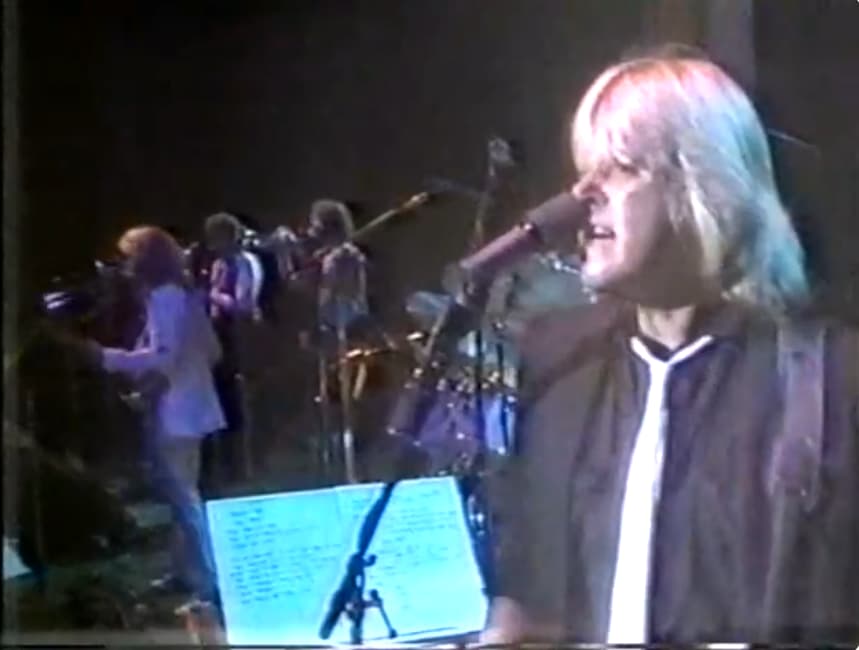
When Power Met Precision: Chicago’s “Aloha Mama” Live in 1979 Reclaims a Forgotten Edge
There is a persistent narrative that reduces Chicago’s legacy to polished ballads and radio friendly hits. Yet performances like “Aloha Mama” from Pine Knob Theatre in 1979 challenge that perception with striking clarity. This live recording reveals a band still deeply connected to its earlier identity, where rock, blues, and jazz coexisted in a dynamic and often unpredictable balance.
At the center of attention is Peter Cetera, whose vocal performance here invites renewed appreciation. Widely known for his smoother and more melodic style in later years, Cetera demonstrates a different dimension in this setting. His voice carries a surprising weight, blending strength with flexibility. Listeners familiar with his studio work may find this contrast unexpected. There is a rawness and immediacy that feels less controlled but more expressive, suggesting a vocalist fully engaged with the moment rather than confined by expectation.
The arrangement of “Aloha Mama” highlights Chicago’s defining characteristic as a band that integrates a horn section not as decoration but as a core structural element. The brass lines move with purpose, interacting with the rhythm section and guitars in a way that feels both tight and spontaneous. Observers have noted that other televised versions from the same era pushed the Dixieland influence even further, emphasizing the band’s willingness to explore stylistic boundaries within a single performance.
What stands out most in this recording is the sense of cohesion. Each musician contributes without overshadowing the others, creating a collective sound that feels larger than any individual part. The extended ending passages, with their layered textures and gradual shifts in intensity, demonstrate a level of musical communication that can only develop through years of playing together.
For longtime viewers, this performance carries a strong element of nostalgia. Broadcast during a period when Chicago was still evolving its identity, it represents a moment before the band fully transitioned toward a softer mainstream direction. That context shapes how the footage is received today. It is not simply about the song itself, but about what it represents within the broader arc of the band’s career.
There is also an enduring fascination with Cetera’s stage presence. Beyond the voice, his physical expression adds another layer to the performance. Subtle changes in phrasing are mirrored in facial gestures and movement, creating a visual dimension that enhances the musical experience.
Ultimately, “Aloha Mama” at Pine Knob stands as a reminder that Chicago’s story is more complex than commonly portrayed. It captures a band capable of power, nuance, and stylistic range, all within a single live performance that continues to resonate with those who revisit it.