
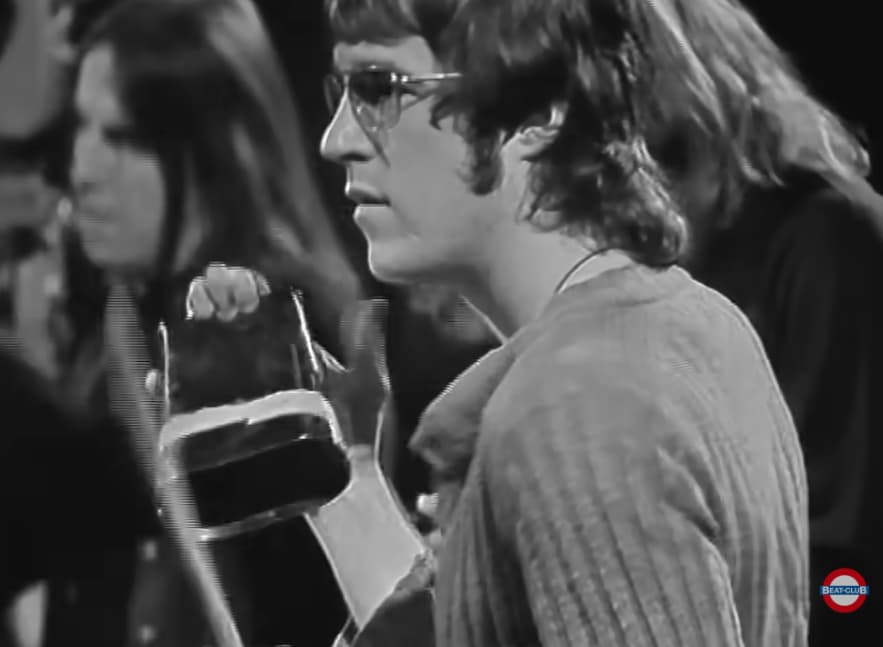
Before the Ballads: Chicago’s Explosive 1969 Identity Captured on “I’m A Man”
A restored clip of Chicago Transit Authority performing “I’m A Man” at the Beat Club in Bremen in 1969 is drawing renewed attention to a period of the band’s history that differs sharply from its later mainstream image. Long before chart topping ballads defined their commercial success, Chicago emerged as a bold, experimental ensemble blending rock with brass driven arrangements.
Formed in 1967 in Chicago, the group initially positioned itself as what members often described as a rock and roll band with horns. This early identity is fully evident in “I’m A Man,” a track that combines extended instrumental passages with a raw, improvisational edge. The Beat Club performance captures that energy in a live television setting, offering a rare look at how the band translated complex arrangements into a tight, unified performance.
Central to this moment is guitarist Terry Kath, whose playing anchors the performance with a powerful, distorted tone that contrasts with the precision of the horn section. Kath’s contribution has increasingly become a focal point in retrospective discussions, with many listeners highlighting his role in shaping the band’s early sound. His approach to the guitar in this clip demonstrates a level of intensity that is often absent from later eras of the band’s output.
The lineup featured in this period also includes Peter Cetera, whose later departure in 1985 would mark a significant transition in the group’s direction. While Cetera would go on to achieve solo success, this early footage shows him as part of a collective unit where no single element dominates. Instead, the performance emphasizes interaction between rhythm section, horns, and vocals.
For many viewers revisiting this clip, the contrast between early Chicago and the band’s later catalog has become a central point of discussion. The polished ballads that brought widespread commercial recognition in the late 1970s and 1980s represent only one phase of a much broader musical journey. Footage like this serves as evidence of a more aggressive and exploratory foundation that is less familiar to casual audiences.
The significance of the Beat Club appearance extends beyond nostalgia. It documents a moment when American rock bands were experimenting with form and structure, pushing beyond conventional formats. Chicago’s ability to integrate jazz influences into a rock framework positioned them as innovators within that landscape.
As debates continue about which era best defines the band, this performance of “I’m A Man” remains a compelling reference point. It reminds viewers that before the radio hits and softer arrangements, Chicago built its reputation on ambition, complexity, and a willingness to challenge expectations in a live setting.