
A Glittering Anthem and a Complicated Legacy: Revisiting a Defining Television Moment in 1973
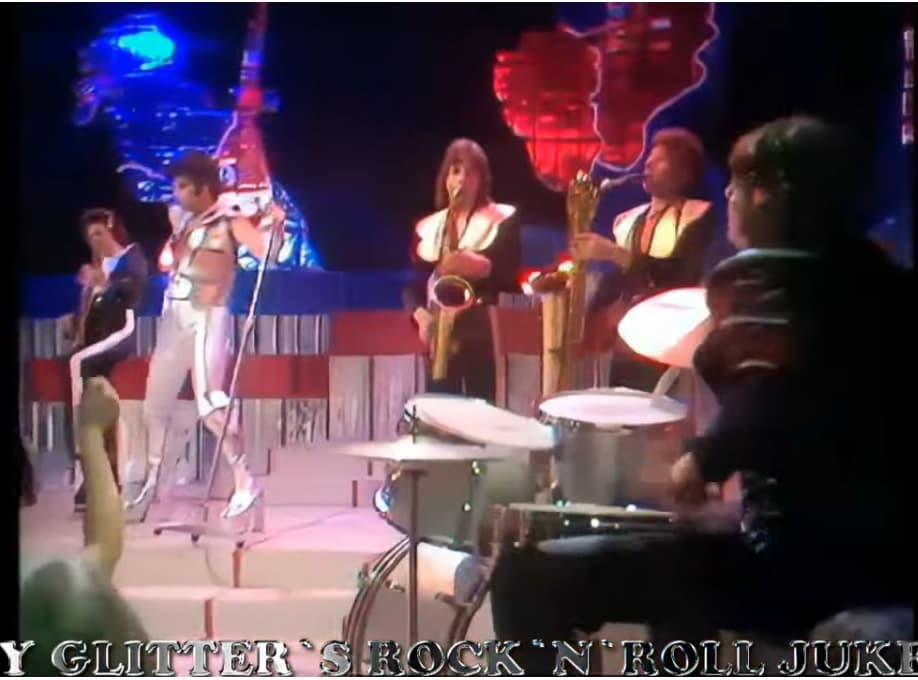
In the winter of 1973, a performance on Top of the Pops captured a moment when pop music, television, and visual identity converged with striking force. At the center stood Gary Glitter, delivering “I’m the Leader of the Gang (I Am)” with a confidence that blurred the line between performer and persona. Decades later, the clip remains both a vivid snapshot of glam rock’s peak and a subject of ongoing cultural debate.
The performance reflects a period when music television was becoming a powerful engine for shaping public taste. Top of the Pops did more than showcase songs. It created icons. In this setting, image was inseparable from sound, and few artists embodied that fusion as completely as Gary Glitter. His appearance, marked by bold, shimmering attire and theatrical presence, was not an accessory to the music but an extension of it.
“I’m the Leader of the Gang (I Am)” functions as more than a pop hit. It is a declaration, a carefully constructed identity set to rhythm. The song’s structure is direct and immediate, built around a chant like refrain that invites participation. In the televised performance, that simplicity becomes a strength. The audience, whether present in the studio or watching at home, is drawn into a collective experience, transforming the song into something communal.
Yet the clip also highlights the mechanics of television performance in that era. Many appearances on Top of the Pops relied on playback or partial live elements, raising questions about authenticity. In this case, the focus shifts away from technical purity and toward presentation. What matters is the impact, and by that measure, the performance succeeds in commanding attention and defining a moment.
Viewed today, the footage carries a dual significance. On one hand, it preserves the energy and aesthetic of glam rock at its most visible. On the other, it invites reflection on how audiences engage with art when the legacy of the artist becomes controversial. The tension between nostalgia and critical reassessment adds complexity to what might otherwise be a straightforward celebration.
Ultimately, the performance endures because it captures a turning point in popular culture. It shows how a song, a persona, and a television platform can align to create something memorable and influential. In that brief broadcast, Gary Glitter did more than perform a hit single. He presented a vision of pop stardom that continues to resonate, even as its meaning evolves over time.