
A Glittering Hit and a Complicated Legacy: Revisiting a Defining Moment of 1973 Pop Culture
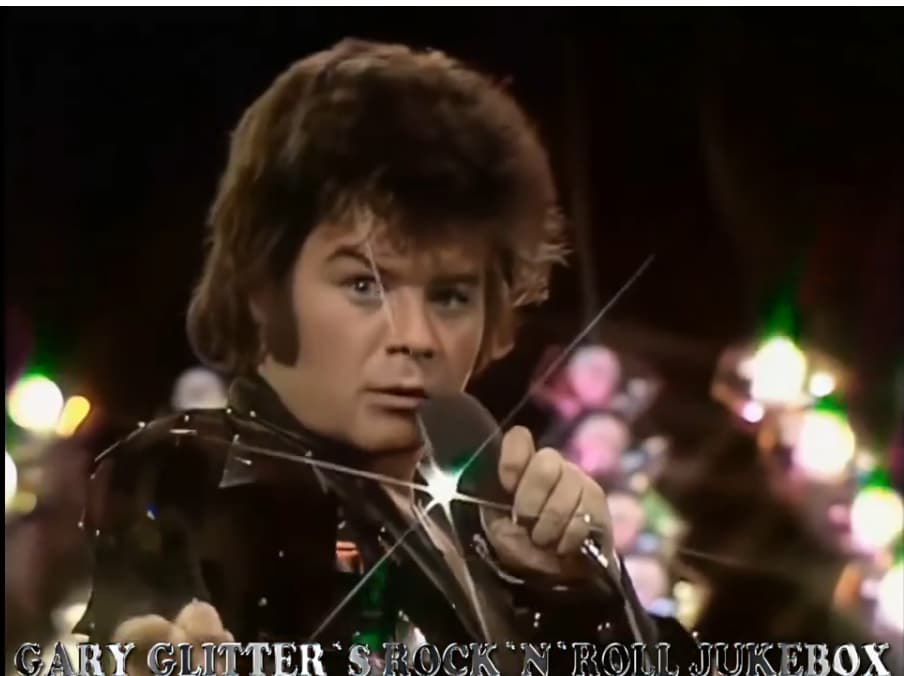
A vivid performance from November 1973 places Gary Glitter at the center of one of the most recognizable pop spectacles of its time. Broadcast on Top of the Pops, “I Love You Love Me Love” captures not only a chart dominating single but also a wider cultural moment when television, image, and music converged to create instant icons.
The performance reflects the height of the glam rock movement, where presentation carried as much weight as sound. Glitter’s stage presence is unapologetically bold, defined by shimmering attire and commanding gestures that draw the viewer in from the first note. The visual impact is immediate, yet it is the song’s structure that ensures its lasting imprint. Built on repetition and a chant like hook, the track demonstrates how simplicity, when executed with confidence, can achieve remarkable reach.
Behind the spectacle stands The Glitter Band, whose driving rhythm provides the foundation for the entire performance. Their signature stomp creates a sense of momentum that feels both primal and precise, giving the song its unmistakable identity. It is a reminder that the success of glam rock often depended on a tightly controlled rhythmic core, even when the spotlight focused elsewhere.
The significance of this broadcast extends beyond its immediate success. At a time when television exposure could determine a song’s commercial fate, appearances on Top of the Pops functioned as a gateway to mass recognition. “I Love You Love Me Love” would go on to achieve extraordinary sales, becoming one of the era’s defining singles and marking a milestone in the evolution of chart driven pop.
Yet any contemporary viewing of the clip inevitably introduces a more complex layer of interpretation. The legacy of Gary Glitter has become deeply controversial, prompting ongoing debate about how audiences engage with art shaped by problematic figures. For some, the performance remains a snapshot of musical history that can be appreciated within its original context. For others, it raises difficult questions about separation between artistic output and personal conduct.
What endures without dispute is the clip’s ability to evoke a specific time and place. It offers a window into an era when pop music embraced theatricality with open arms and when a single television appearance could define a career. In revisiting this performance, viewers are not only encountering a hit song but also engaging with the layered realities of cultural memory, where celebration and critique often exist side by side.