
From Seventies Stardom to Eighties Reflection A Performance That Sparks Debate
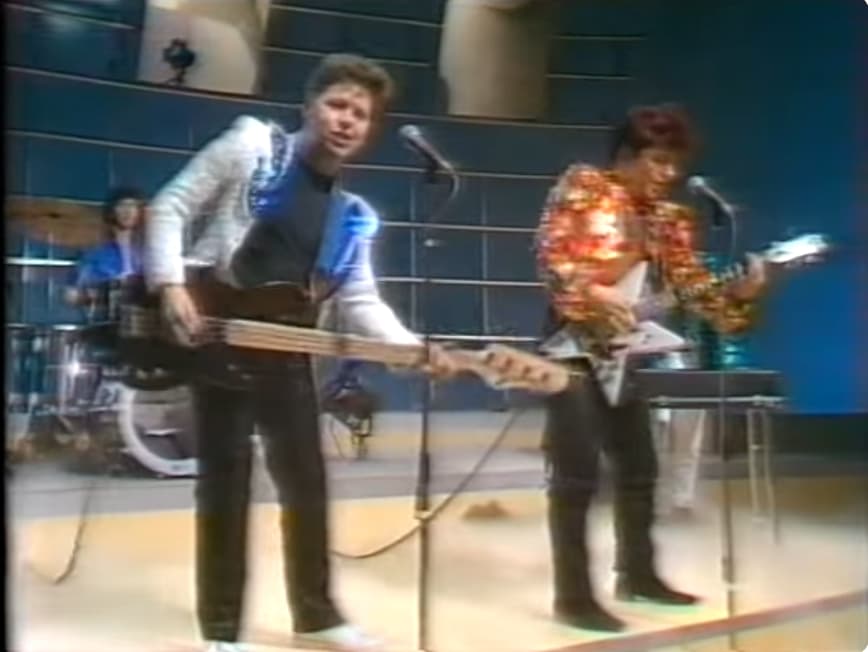
A television appearance from 1983 featuring The Glitter Band performing their earlier hit “Angel Face” offers a revealing snapshot of a group navigating its past and present. Broadcast on Greatest Hits of 1974 and hosted by Mike Smith, the performance brings together nostalgia, changing industry practices, and ongoing questions about authenticity in televised music.
By 1983, the lineup had evolved, with Gerry Shephard, John Springate, and Tony Leonard representing the band on stage. Their decision to revisit “Angel Face,” a song closely associated with their mid seventies success, reflects a broader trend of the era, where television programs often invited artists to perform established hits for audiences eager to reconnect with familiar material. The inclusion of archival footage of “Let’s Get Together Again” from 1974 further reinforces this sense of looking back, creating a layered viewing experience that contrasts past vitality with present reality.
The performance itself raises notable points of discussion. Viewers have observed that certain elements appear staged in line with television practices of the time. Instrumental miming was not uncommon, particularly on programs that prioritized broadcast consistency over fully live setups. This becomes evident in moments where instrumentation does not entirely align with the original recording, prompting questions about what is being performed live and what is being reproduced for the sake of presentation. At the same time, the vocal delivery remains a focal point, with listeners highlighting the presence and tone of Gerry Shephard as a defining element.
Beyond the technical aspects, the clip carries an undercurrent of reflection on the band’s history. Discussions among viewers often turn to the group’s earlier association with the glam rock movement and the challenges they faced in maintaining both identity and recognition after shifts in management and industry dynamics. While the performance itself does not address these issues directly, its context invites consideration of how external factors can shape the trajectory of a band’s career.
There is also a more subtle layer of engagement tied to audience perception. For some, the performance represents a welcome return to a style of music that defined a particular moment in popular culture. For others, it highlights the tension between memory and reality, where the energy of original recordings is difficult to replicate within the constraints of a television format.
Ultimately, this 1983 appearance stands as more than a simple reprise of “Angel Face.” It documents a band revisiting its legacy in a controlled broadcast environment, offering viewers an opportunity to reflect on how music endures, adapts, and is remembered across time.