
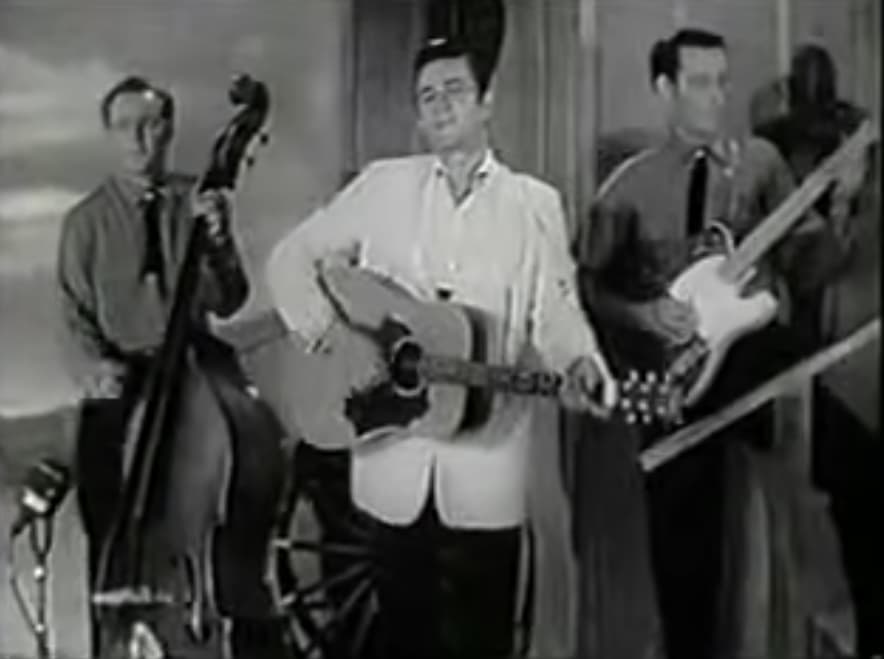
Johnny Cash Before the Legend: Rare 1956 “I Walk the Line” Performance Resurfaces
A rare recording of Johnny Cash performing “I Walk the Line” in 1956 continues to circulate widely on YouTube, drawing attention from both long time fans and new listeners discovering his early work. The performance is commonly associated with the Big “D” Jamboree in Dallas, a regional radio program that featured rising country acts during the mid twentieth century.
At the time of this recording, Cash had only recently released “I Walk the Line” under Sun Records. The song would go on to become his first number one country hit and a defining piece of his career. In this early live setting, however, the presentation is notably restrained. There is no elaborate staging, no large backing band, and no theatrical delivery. Instead, the focus rests almost entirely on Cash’s voice and his steady guitar rhythm.
Listeners familiar with the track often notice a technical detail that sets it apart. Cash subtly shifts vocal pitch between verses, a deliberate choice that adds tension and structure to an otherwise simple arrangement. He has spoken about using a low humming technique to guide these transitions, reflecting a disciplined approach that contrasts with the song’s plain surface.
The lyrical theme of “I Walk the Line” centers on fidelity and personal restraint, written during Cash’s early marriage to Vivian Liberto. This context has become part of the song’s enduring narrative, especially given the well documented complexities of his later personal life. For many viewers, this early performance carries an added layer of meaning as a snapshot of intention before experience reshaped the artist.
Comments on YouTube frequently highlight the raw quality of the recording. Viewers describe it as honest, unpolished, and direct. Some note that the absence of production enhances its emotional clarity, while others point to the historical value of hearing Cash at a formative stage. A recurring sentiment is that the performance feels closer to a private moment than a public show.
Archival material from this period remains limited, which adds to the significance of recordings like this one. While not originally produced for wide distribution, the clip now functions as an important document of Cash’s early development and the broader country music scene of the 1950s.
Decades later, “I Walk the Line” remains one of Johnny Cash’s most recognizable songs. This 1956 performance does not present the fully formed icon, but rather the foundation. For audiences today, that may be precisely its greatest value.