
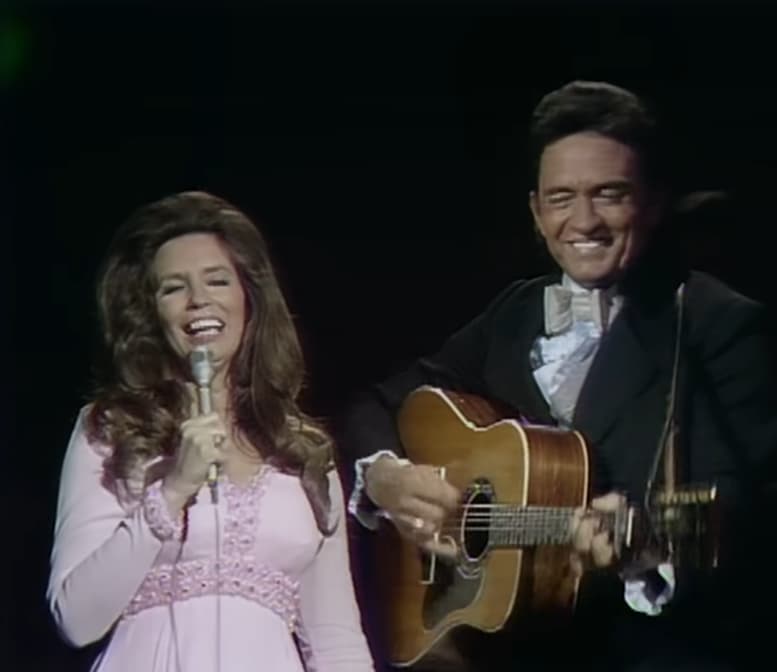
A Love Story Unscripted Lights Up The Stage In Johnny Cash And June Carter’s “Jackson” Performance
In an era defined by polished television and carefully controlled performances, a clip from The Johnny Cash Show continues to stand apart with rare authenticity. The live rendition of Jackson by Johnny Cash and June Carter captures more than music. It reveals a relationship unfolding in real time before a national audience.
Recorded at the historic Ryman Auditorium, the performance reflects a pivotal moment in Cash’s career. He had already reshaped his public image through raw, unfiltered concerts and now brought that same honesty to television. Unlike most programs of its time, his show allowed space for spontaneity, creating an environment where genuine emotion could surface without restraint.
From the opening line, delivered with Cash’s signature restraint, the contrast becomes clear. June Carter enters with warmth and playful defiance, transforming the duet into a lively exchange rather than a conventional performance. Their timing feels instinctive. Glances, smiles, and subtle gestures replace theatrical exaggeration. The result is a dynamic that feels less like entertainment and more like a private conversation shared with millions.
What makes this moment especially compelling lies in its underlying irony. The song itself portrays a couple drifting apart, trading sharp remarks and restless ambitions. Yet offstage, Cash and Carter were deeply connected, their relationship rooted in mutual admiration and growing commitment. This contrast adds a layer of emotional complexity that audiences continue to find captivating.
As the performance unfolds, the energy shifts naturally between tension and humor. Carter’s quick reactions and expressive delivery draw the audience in, while Cash maintains a steady presence that grounds the exchange. Together, they create a rhythm that extends beyond the music, one shaped by trust and familiarity.
The closing moments offer a quiet resolution. A shared smile replaces lyrical tension, hinting at a deeper bond that the song itself only pretends to question. It is a subtle but powerful conclusion, reinforcing the sense that what viewers have witnessed is something genuine.
Decades later, the clip remains widely circulated, not simply as a piece of musical history but as a study in authenticity. In a medium often defined by performance, this duet endures as proof that truth, even in its simplest form, can be the most compelling spectacle of all.