
Once or Twice When Imperfection Reveals the Truth of Chicago’s Golden Era.
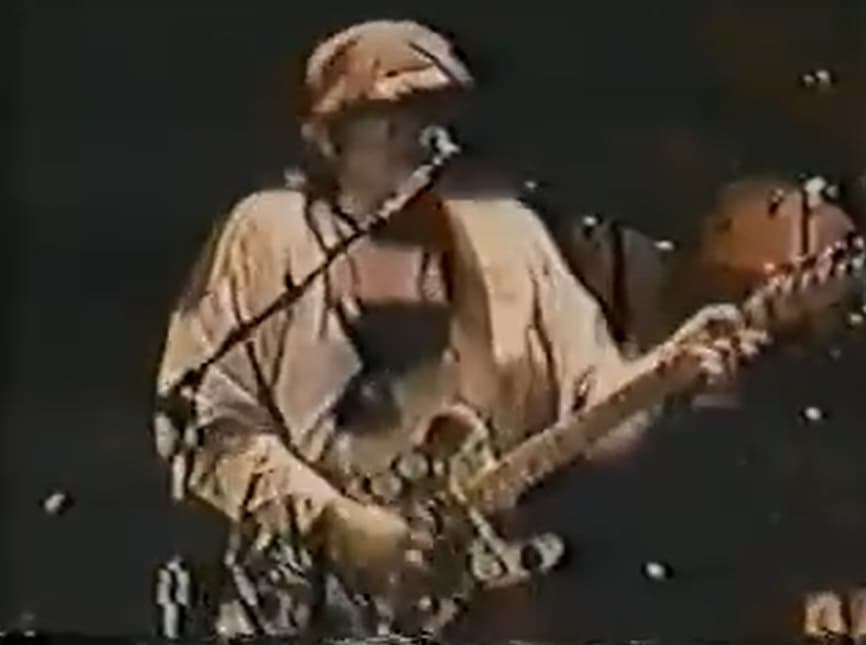
A grainy live recording of “Once or Twice” from 1976 has quietly reignited a familiar debate among listeners of Chicago. The sound quality is far from pristine, the visuals lack the polish modern audiences expect, yet the performance itself carries a force that is difficult to dismiss. At the center stands Terry Kath, a figure whose legacy continues to provoke both admiration and lingering questions about recognition.
Drawn from the era surrounding the album Chicago X, this performance captures the band at a moment when commercial success and musical ambition were aligned. “Once or Twice” may not rank among their most celebrated hits, but in a live setting it becomes something more revealing. The arrangement opens space for Kath to move beyond structure, shaping phrases with a fluidity that feels instinctive rather than calculated. His guitar work does not simply decorate the song. It defines its emotional core.
What makes this recording particularly compelling is the contrast between technical limitation and artistic clarity. Listeners are forced to engage differently, to listen through the imperfections rather than be guided by production. In doing so, many discover a rawness that modern recordings often smooth away. The performance feels immediate, almost confrontational in its honesty, as if it demands attention without offering comfort.
The mythology surrounding Kath inevitably enters the conversation. Stories of Jimi Hendrix praising his playing at Whisky a Go Go have long circulated, reinforcing the idea that Kath’s talent was recognized by peers even if broader audiences overlooked it. Whether one views such anecdotes as definitive proof or as part of rock folklore, they shape how this performance is received. For some, it confirms a long held belief that Kath belongs in the highest tier of guitarists. For others, it raises the question of why that status was never fully secured during his lifetime.
The discussion does not end with Kath alone. It extends to Chicago as a whole and to the trajectory the band would later follow. Many listeners point to performances like this as evidence of a more adventurous identity, one that blended rock, jazz, and brass in a way few groups attempted. Comparisons with later eras often carry a tone of disappointment, suggesting that something vital was lost as the band’s sound evolved.
Yet there is another perspective worth considering. Perhaps what resonates so strongly in this recording is not simply what Chicago was, but what live music itself can be when stripped of excess. There is no safety net here, no digital correction, only musicians responding to one another in real time.
In the end, “Once or Twice” survives not because it is flawless, but because it is alive. And in that vitality, Terry Kath’s presence continues to challenge how greatness is measured and remembered.