
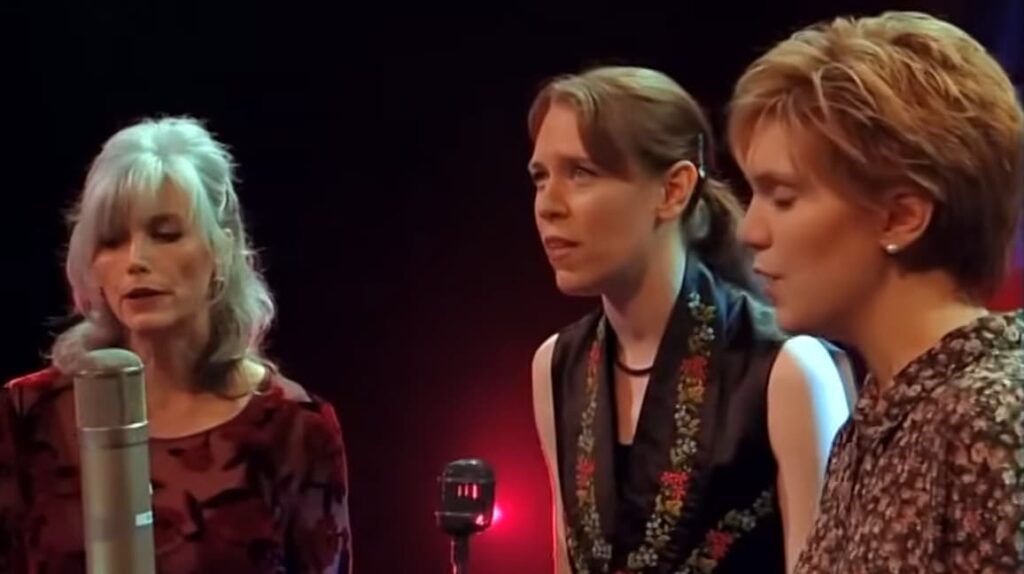
Three Voices, One Spellbinding Silence: Emmylou Harris, Gillian Welch, and Alison Krauss Redefine Vocal Harmony
A widely shared performance of “Go To Sleep You Little Baby” featuring Emmylou Harris, Gillian Welch, and Alison Krauss has renewed discussion about the enduring power of unadorned vocal music. The clip, associated with the cultural legacy of the film O Brother, Where Art Thou?, presents a rare moment in modern performance where instrumentation is absent and vocal precision carries the entire emotional weight.
The performance stands out for its disciplined restraint. There are no visible instruments, no layered production effects, and no reliance on studio enhancement. Instead, the three singers deliver tightly interwoven harmonies that reflect a deep understanding of traditional American roots music. Each voice occupies a distinct tonal space, yet blends seamlessly into a unified sound that feels both intimate and technically exact.
Audience reactions captured in online commentary highlight how unusual such a presentation feels in a contemporary context. Many listeners note the near silence in the room, with the crowd fully attentive, underscoring the gravity of the moment. The absence of distraction places full emphasis on phrasing, pitch control, and emotional delivery. This is not a display built on spectacle but on musical discipline and interpretive clarity.
The song itself, drawn from American folk tradition, benefits from this stripped down approach. Its lullaby structure and repetitive phrasing require careful handling to avoid monotony. Harris, Welch, and Krauss address this through subtle dynamic shifts and precise harmonic alignment. Their phrasing suggests a shared musical intuition, with each singer able to anticipate and support the others without overshadowing the collective sound.
Discussion around the performance has also touched on the role of instrumentation in vocal music. Some viewers question whether the absence of instruments diminishes the experience. However, the consensus among many listeners is that this particular rendition demonstrates the opposite. By removing instrumental support, the singers expose the core mechanics of harmony singing, revealing both its difficulty and its expressive potential.
The performance also reinforces the historical significance of the O Brother, Where Art Thou? Soundtrack, which played a major role in reviving interest in traditional American folk and bluegrass at the turn of the century. This clip serves as a living extension of that influence, showing how these songs continue to resonate when performed with authenticity and technical care.
Ultimately, the video offers a clear example of how vocal artistry alone can command attention. Without visual excess or production layers, the focus returns to the fundamentals of music making. Precision, balance, and emotional sincerity define the performance, reaffirming why these three artists are often regarded among the most accomplished vocalists in their field.
 Oldies Songs