
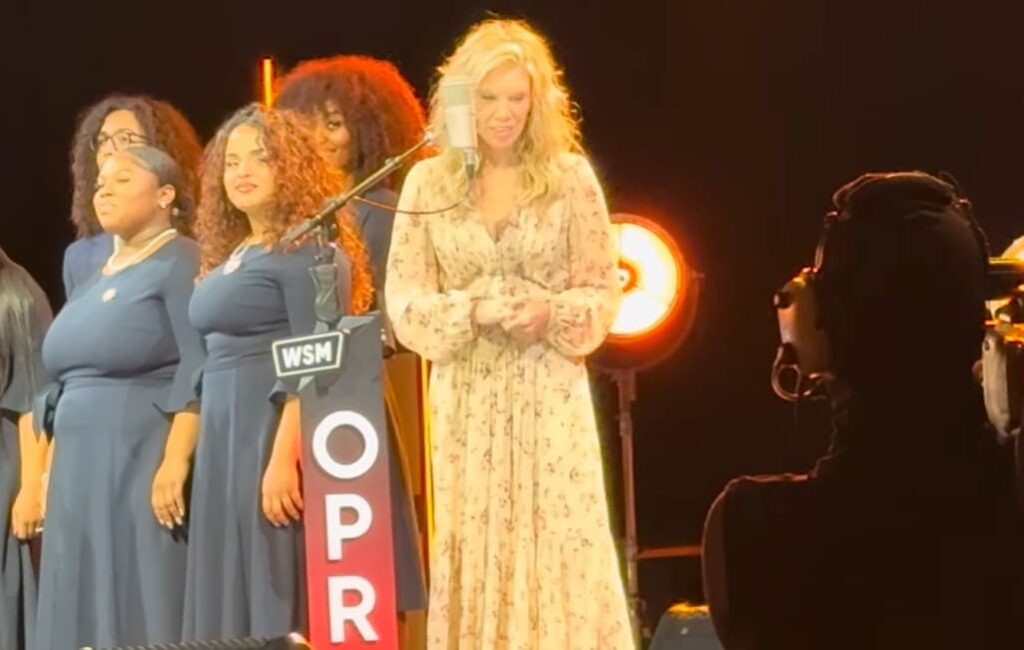
A Night of Reverence and Legacy as Alison Krauss Joins the Fisk Jubilee Singers at the Grand Ole Opry
On February 28, 2026, the stage of the Grand Ole Opry House in Nashville became the setting for a performance rooted deeply in American musical heritage. As part of the Opry 100 celebration tied to the cultural legacy of O Brother, Where Art Thou?, Alison Krauss appeared alongside the Fisk Jubilee Singers to deliver a moving rendition of the traditional gospel song “Down To The River To Pray.”
The performance brought together two distinct but complementary traditions. Alison Krauss, long celebrated for her crystalline tone and understated delivery, approached the song with restraint and clarity. Her vocal phrasing avoided excess, allowing the spiritual gravity of the material to remain at the forefront. The Fisk Jubilee Singers, known for preserving the legacy of African American spirituals since the nineteenth century, provided a choral foundation that added depth and historical resonance.
The arrangement leaned into simplicity. There was no reliance on elaborate instrumentation or theatrical staging. Instead, the focus remained on vocal interplay and tonal balance. The Jubilee Singers sustained a steady harmonic structure, while Krauss floated above with a lead that felt both intimate and reverent. This contrast created a layered sound that resonated strongly within the acoustics of the Opry House.
The event also carried historical undertones beyond the performance itself. The Fisk Jubilee Singers have a documented connection to early American broadcasting through WSM, the station that would later become synonymous with the Grand Ole Opry. Their predecessors are believed to have performed during the station’s earliest days more than a century ago. Their presence on this anniversary program reinforced a sense of continuity between past and present.
Audience reactions reflected both admiration and emotional engagement. Many attendees and viewers noted the purity of the vocal blend and the spiritual atmosphere created on stage. Commentary surrounding the performance frequently highlighted Krauss’s ability to convey vulnerability without sacrificing technical precision. At the same time, the Jubilee Singers were widely praised for maintaining the authenticity of the gospel tradition while adapting seamlessly to a modern concert setting.
This collaboration stood as more than a musical highlight. It functioned as a cultural bridge, connecting bluegrass, country, and gospel lineages within a single performance. In an era often defined by rapid stylistic change, the moment served as a reminder of the enduring power of traditional forms when presented with sincerity and respect.
As the Opry marks a century of influence, performances like this underscore its role not only as a stage for entertainment but also as a living archive of American music.