
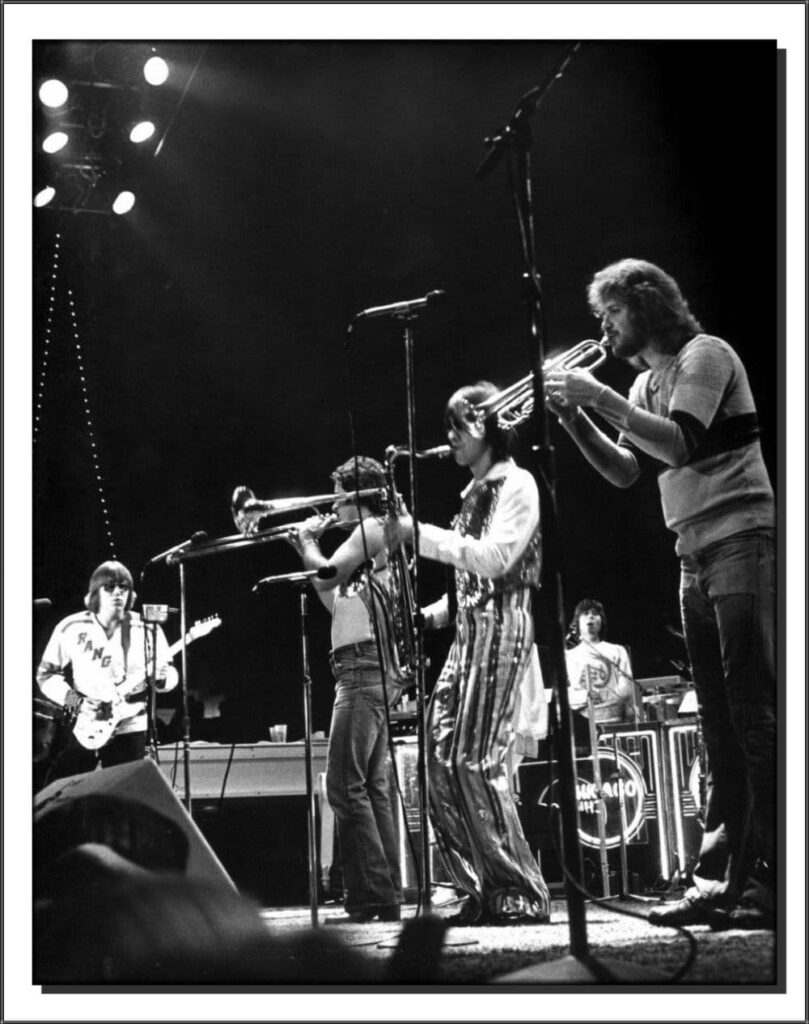
A Rare Broadcast Preserves Chicago at Full Strength and Full Imagination
On September 19, 1976, Chicago appeared on American television with a performance that now carries the weight of both artistry and memory. “Scrapbook,” drawn from the album Chicago X, unfolded as the second piece in the program, following the widely celebrated “If You Leave Me Now.” The placement alone told a story, moving from immediate familiarity into something more intricate and reflective.
“Scrapbook” is not a chart defining single, yet it reveals a dimension of Chicago that casual listeners often overlook. Built on layered arrangements and subtle harmonic movement, the song reflects the band’s ability to merge jazz influenced complexity with the accessibility of rock. In this televised setting, that balance becomes especially clear. Without the scale of a concert arena, the music draws the audience inward, encouraging attention to detail rather than spectacle.
At the center of the performance stands Robert Lamm, whose vocal delivery captures the introspective tone of the composition. His voice carries a conversational quality, allowing the song to unfold as a sequence of reflections rather than declarations. Surrounding him is the unmistakable ensemble sound that defined Chicago during this era, where each instrument contributes to a carefully structured whole.
Equally significant is the presence of Terry Kath. His playing here serves as a reminder of the expressive range he brought to the band. Rather than dominating the arrangement, his guitar lines weave through it, adding texture and emotional depth. For many longtime listeners, performances featuring Kath have taken on added meaning, representing a period when Chicago’s identity was still anchored in experimentation and musical risk.
The broadcast environment adds another layer of historical importance. In the nineteen seventies, access to international music on television was limited in many parts of the world. Appearances like this one became essential windows into the broader landscape of popular music. Decades later, the recording stands as a document of how the band presented itself at a moment of transition, balancing its more adventurous roots with a growing mainstream audience.
Discussion around Chicago often centers on the contrast between its earlier, more complex work and its later commercial success. “Scrapbook” sits firmly within that earlier tradition, offering evidence of a band unafraid to explore structure and mood. It challenges the simplified image of Chicago as a group defined solely by ballads, revealing instead a collective capable of nuance and ambition.
Viewed today, this performance resonates as both a celebration and a record. It captures a band at full creative strength, while also hinting at the changes that would soon reshape its direction. In that sense, “Scrapbook” becomes more than a song. It becomes a moment where artistry, timing, and legacy converge on a single stage.