
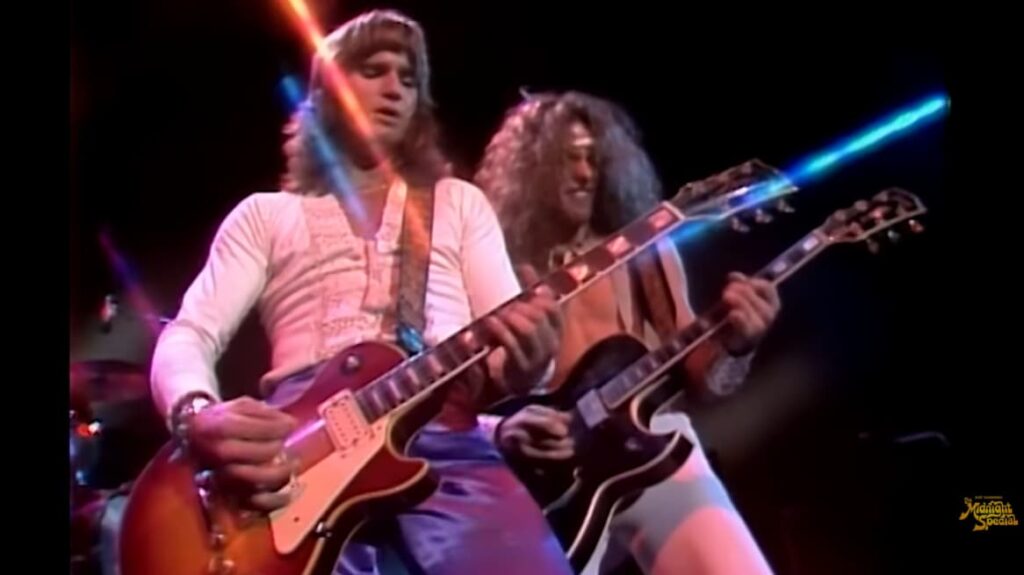
Uncompromising Tension on Late Night Television: Ted Nugent’s “Stranglehold” on The Midnight Special, 1978
On November 24, 1978, Ted Nugent appeared on The Midnight Special with a performance of “Stranglehold” that remains one of the most striking examples of hard rock intensity ever broadcast on late night television. While Nugent’s guitar presence dominated the stage, it was Charlie Huhn’s vocal performance that gave this rendition its particular edge, grounding the song’s simmering power in a voice that was controlled, focused, and quietly menacing.
By the late seventies, “Stranglehold” had already established itself as Nugent’s signature piece. Built on a slow, deliberate riff and a sense of tension that never fully releases, the song thrives on patience rather than excess. Bringing it to a television format was a risk. Yet The Midnight Special allowed space for extended performances, and Nugent used that freedom to present the song without compromise.
From the opening notes, Nugent’s guitar tone set the mood. Thick, muscular, and unwavering, it carried a physical weight that felt almost confrontational. Rather than rushing, the performance leaned into repetition and restraint, allowing the groove to tighten gradually. This approach made the song feel less like a showcase and more like a statement of intent.
At the center of it all stood Charlie Huhn, whose vocal delivery deserves special recognition. His performance avoided dramatics or exaggeration. Instead, he sang with a calm authority that matched the song’s underlying tension. Huhn did not compete with the guitar. He complemented it, giving the lyrics a measured, almost detached presence that intensified their impact. His voice added clarity and focus, ensuring the song’s narrative remained central even as the music surged around it.
The television setting heightened the effect. Without the chaos of an arena crowd, the camera captured the concentration of the band and the seriousness of the performance. Nugent did not play to the audience at home. He played as if the studio itself were a live battlefield, fully committed to the moment. The band locked into the groove with discipline, allowing the song’s hypnotic structure to do its work.
By 1978, Ted Nugent was firmly established as a major figure in American hard rock. Still, this performance did not feel like an exercise in status. It felt raw and present, driven by confidence rather than ego. The decision to let “Stranglehold” unfold slowly on national television spoke to a belief in the song’s power and the audience’s ability to stay with it.
What makes this Midnight Special appearance endure is its honesty. There is no softening for broadcast standards, no attempt to reframe the song for mass appeal. It captures a moment when hard rock trusted its own intensity and when musicians like Nugent and Charlie Huhn understood that tension itself could be the most compelling force on stage.
More than four decades later, this performance remains a reminder of what late night television once allowed, and what rock music, when played with conviction, can still achieve.