
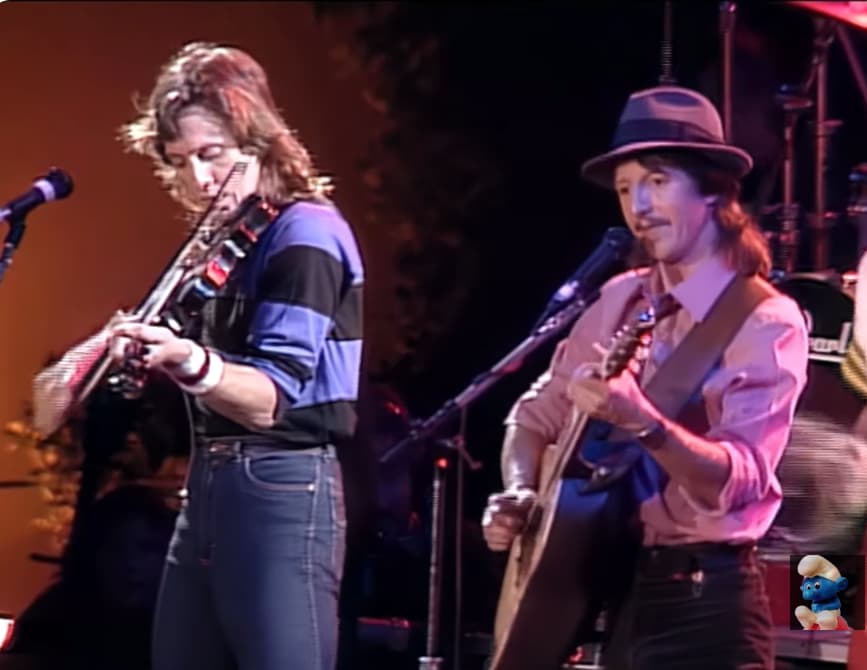
“Black Water” Revisited in 4K as a Defining Doobie Brothers Live Performance Resurfaces
A newly released 4K AI-remastered live video of “Black Water” by The Doobie Brothers, sourced from an original 1982 performance, is drawing renewed attention to one of the most distinctive and unexpected hits of 1970s American rock. Enhanced with upgraded stereo sound and restored visuals, the release offers both longtime fans and new listeners a fresh perspective on a song whose legacy has endured for five decades.
Originally recorded in 1974 for the album What Were Once Vices Are Now Habits, “Black Water” was written and sung by Patrick Simmons. The song went on to become the first No.1 single in the band’s career, reaching the top of the U.S. Billboard Hot 100 in March 1975 and also topping the charts in Canada. Its commercial success was overwhelmingly concentrated in North America, where it became a defining radio staple of the era.
The origins of “Black Water” were almost accidental. Simmons has recalled discovering the song’s central guitar riff while waiting between takes at Warner Bros. Recording Studio during sessions for the 1973 album The Captain and Me. Producer Ted Templeman, hearing the riff through the studio talkback, immediately encouraged Simmons to build a song around it. The writing was completed later during a stay in New Orleans, a city whose musical heritage and everyday rhythms left a lasting impression on Simmons.
A lifelong admirer of Delta blues, Simmons found inspiration in the city’s streetcars, summer rainstorms, and the French Quarter. Elements of the song reflect both childhood imaginings of the American South, shaped by classic literature, and real-life experiences wandering through New Orleans neighborhoods. These impressions gave “Black Water” its distinctive sense of place and atmosphere.
Musically, the track stands apart within the Doobie Brothers catalog. Its relaxed acoustic framework is complemented by a subtle viola performance by Ilene “Novi” Novog and crowned by a memorable a cappella section. That vocal passage later influenced other artists and remains one of the song’s most recognizable features. Templeman later acknowledged that the a cappella idea drew inspiration from earlier pop productions he had been involved with in the 1960s.
Despite its eventual success, “Black Water” was never initially viewed as a potential hit. Templeman himself considered it an “acoustic thing” and placed it on the B-side of “Another Park, Another Sunday.” Only after subsequent singles failed to gain traction did Warner Bros. reissue “Black Water” as an A-side, a decision that proved pivotal.
The newly remastered 1982 live performance underscores why the song continues to resonate. Decades on, “Black Water” remains a rare blend of folk, rock, and Americana, now preserved in high definition as both a historical document and a timeless piece of American music history.